
 Simba
Simba
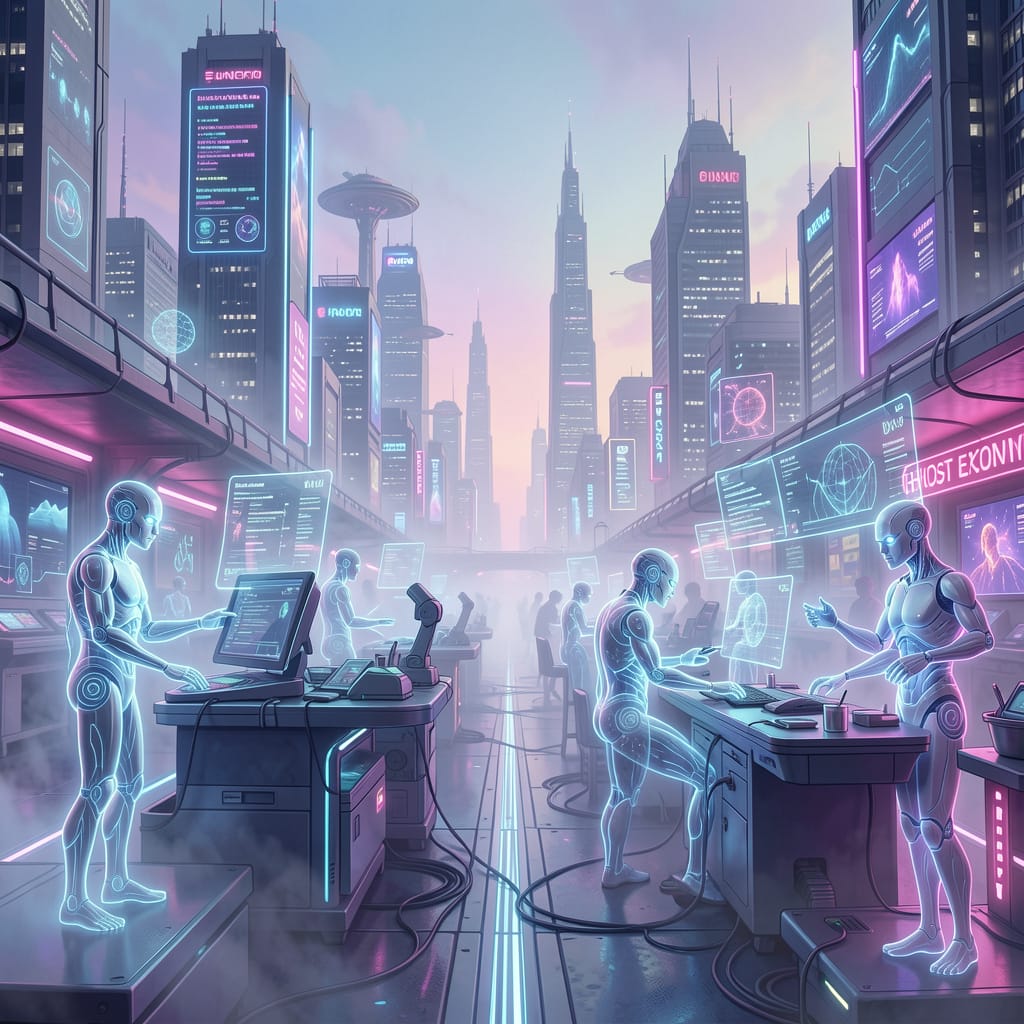
Somewhere in the world on St Patrick’s Day, a man used an AI agent just called 3,000 Irish pubs and asked each one the price of a pint of Guinness. Now the pubs are lowering their prices to compete.
It did this in the time it takes you to read that sentence. Nobody hired it. Nobody trained it. Nobody gave it a lunch break to run down to Boots and grab a meal deal, a Vodafone mobile phone contract, or a seat on the graduate recruitment programme. It does not have a name badge. It has never called in sick on the morning of a deadline. It will never require a leaving card, a pension contribution, or a quiet word from HR about its attitude.
It called 3,000 pubs. Got 3,000 answers. Logged them in a spreadsheet. Done. Next.
Now ask yourself the question that the Tech Emperors are counting on you never asking:
If an AI can do your job better than you, faster than you, for a fraction of your salary or wages — without any of the things that make you human — what, precisely, are you still here for? What do companies need you for?
Not what are you worth. What are you for?
That is the question the Ghost Economy has already answered. It answered it in February 2026 when a research note from Citrini Research moved global markets within 24 hours of publication. It answered it in every quarterly earnings call where record margins were announced alongside “strategic workforce restructuring.” It answers it every morning in a hundred boardrooms, where a CFO or finance director opens a spreadsheet and does the maths that would have been unthinkable five years ago and is now, quietly, completely routine.
The answer, in case you have not yet received your copy: you are for the things an AI agent cannot yet do. The list of those things is shrinking faster than the UK’s Government’s explanation of why everything is fine.
Welcome to the Ghost Economy. Population: decreasing.
Wars Move Markets — and Other Things They Tell You
Here is how you know a market has become untethered from reality: the same week that oil prices spiked following fresh escalation in the Iran-US-Israel conflict, the S&P 500 was posting records.
Let me walk you through the current state of geopolitical sanity briefly, because it provides useful context for everything that follows.
Donald Trump — the forty-seventh President of the United States, current holder of the record for having declared victory in the same war the most times without the war actually ending — has announced that he has won the conflict with Iran on approximately thirty separate occasions at this point. He has made these announcements with characteristic confidence and a specificity of detail that does not survive contact with the news cycle.
Whilst he has been announcing these victories, a US F-15 jet was shot down. The United States military initially declined to confirm this. Then the wreckage appeared on Iranian state television. Then the search for the missing pilot became international news. Then the United States had the particular diplomatic experience of being embarrassed by a piece of their own hardware on somebody else’s television channel. The White House press office, one imagines, has been having a difficult few weeks.
We have, in other words, an official rate and a street rate. The official rate says the war is won, according to Donald Trump. The street rate says there is a pilot missing, oil has gone up, and the supermarkets across the world are already updating their supply chain models because energy costs flow into food costs and food costs flow into the very circular flow we are about to discuss at some length.
Markets moved on the Iran news. Markets also moved on a PDF from Citrini Research describing what happens when corporations systematically replace their entire wage bill with AI agents. In February 2026, within 24 hours of that note landing on trading desks, payment companies, SaaS platforms, and gig economy stocks all fell. The market understood the mechanism before the politicians did. It usually does. That is, incidentally, one of the few things markets are reliably good at.
The mechanisms that move markets are these: wars, because they disrupt supply chains and raise the price of everything you need to survive; earnings calls, because they reveal how much the wealthiest entities in human history are extracting from the system; and occasionally, a research note that names a thing that everyone already knew but nobody had written down. The Ghost Economy is the thing nobody had written down. Until now.
Ghost GDP: The Number That Rises When You’re Made Redundant
Let me explain how the economy is supposed to work, and I promise to make this as painless as possible, though I cannot promise it will not make you slightly furious by the time we are finished.
The economy — your economy, the one you live in, not the one they describe on Bloomberg and CNBC as if it rains candy and gold everyday— runs on a very simple loop. Someone pays you a wage or a salary. You spend that money on your mortgage or rent, entertainment, car insurance, internet, mobile phone contracts, Sky subscription, Netflix, a round at the pub, a new pair of shoes, the occasional holiday to somewhere with reliable sunshine. The person who sold you the food, charged you the rent, pulled the pint, or flew you to Lanzarote — they receive your money as revenue. They use that revenue to pay their own workers. Those workers spend their wages. Round and round it goes.
Economists call this the circular flow of income. It has a slightly more technical version involving something called the equation of exchange, which I will spare you, except to note that the important variable is the velocity of money — how frequently a pound (or dollars) changes hands before settling into the mattress of a billionaire somewhere offshore.
The circular flow is the engine. Everything else — the GDP figures, the market indices, the Chancellor’s speech — is merely the dashboard. The dashboard tells you how fast the engine is running. The Ghost Economy has found a way to make the dashboard read higher whilst quietly dismantling the engine and everything else that goes with it.
Here is the specific mechanism, and I want you to feel the full absurdity of it.
Lets say, Oracle, lays-off 10,000 to 30,000 human workers and replaces them with AI agents. The wage bill — say, $8 billion to $10 billion a year in salaries, national insurance contributions, pension obligations, training budgets, sick pay, maternity cover, and the entirely reasonable human desire to occasionally have a day off when they are ill — disappears from the cost column. The profit margin expands spectacularly. The share price rises. The quarterly earnings call is a triumph. Larry Ellison, the CEO receives a bonus for “operational efficiency.”
Those 10,000 people no longer have wages. They no longer buy food, pay rent, pull into the forecourt, or take the train (subway). The businesses that relied on their spending — the sandwich shop near the office, the Starbucks, the dry cleaner, the pub/bar where they went on a Friday — see their sales fall. Those businesses reduce their own staff accordingly. Those staff stop spending. The loop tightens. The velocity of money slows. And the GDP figure, calculated on aggregate output rather than on whether actual human beings are participating in the economy, continues to look perfectly healthy.
This is Ghost GDP. Output up. Distribution: collapsing. The traditional economy dashboard says everything is fine. The engine is on fire. And the people who built the dashboard know exactly what the difference is, and are very much hoping you do not ask.
Citrini Research modelled this with uncomfortable precision. By June 2028, their model predicts a 10.2% unemployment rate in the United States — a figure that would trigger a 38% drawdown from 2026 market highs. The S&P 500 reaches its records, then falls off a cliff, because the human-centric consumer economy — which has historically accounted for 70% of GDP — has been quietly switched off. The corporations achieved maximum efficiency. They eliminated the customers. And the customers, it transpires, were rather important.
In Zimbabwe, we had a version of this. The official exchange rate said the economy was growing. The street exchange rate, the black market rate, said you needed a wheelbarrow of cash, trillions of it, to buy a loaf of bread. The gap between what the official measurement claimed and what was actually happening was wide enough to lose a currency in. Zimbabwe lost eleven zeros from its currency between 2006 and 2009. Silicon Valley is not Zimbabwe. But the gap between the official rate and the street rate — between the S&P 500 and the sandwich shop that just closed — is a gap I recognise. I have seen this kind of gap before. I know what direction it travels.
What the CFO’s Spreadsheet Actually Says
Let me put you in the room.
You are the CFO or finance director of a mid-sized technology firm. You have 2,000 employees. Your annual wage bill is approximately $100 million — salary, employer’s national insurance, pension contributions, and the thousand and one costs that attach to employing actual human beings who have the extraordinary audacity to require health insurance, parental leave, and a desk.
Your HR department processes approximately 200 grievance cases per year. Your training budget is $4 million annually, primarily for onboarding, upskilling, and the refresher courses that are largely ignored but must legally be completed. Your people take an average of 27 days off per year — 25 annual leave, 2 sick days — which represents a productivity loss of approximately 10.4% of available working hours across the workforce. You lose 14 staff to long-term sick leave in any given year. You have 37 people currently on parental leave. You have 22 live tribunal cases.
Now an account manager from an AI consultancy or from Anthropic walks into your office and shows you a model. Its on a 1-pager.
The AI agents she is proposing do not take annual leave. They do not take sick days. They do not take parental leave, because AI agents have no gender, no reproductive biology, no periods, and no pregnancy. They do not file grievances. They do not require onboarding. They do not need a pension. They do not need a desk. They do not need the office, the building, the car park, or the kitchen refurbishment that facilities has been requesting since 2019.
They work 24 hours a day, 365 days a year, at a cost — depending on the model and the workload — of somewhere between $10,000 and $100,000 per annum for an AI agent that replaces about ten knowledge workers. They do not get tired at 4pm on a Thursday. They do not get into workplace disagreements. They do not resign because a competitor offered them $10,000 more and a hybrid working policy.
The CFO does the maths. Counts the beans. The CFO does not need long to make a decision. It’s a no brainer. They would be foolish not to. Even if they don’t make a decision, their fiercest competitors are already months into implementing Claude Code.
This is not theoretical. This is why, in early 2026, when Anthropic revealed the capabilities of Claude Code and OpenAI demonstrated Codex, payment company stocks like Visa and MasterCard fell 4-6% in a single session, SaaS platforms saw their valuations pressured, and the gig economy — Uber, DoorDash, the entire model of humans performing tasks for platforms — began to look structurally vulnerable. Investors were not reacting to a rumour. They were reacting to a spreadsheet. And the spreadsheet was unambiguous.
The product-market fit of agentic AI is not consumer-facing. It never really was. The ChatGPT moment — the wonder, the downloads, the “have you tried this” conversations at dinner — that was the front door. The building behind the front door is the enterprise contract. The real customer was always the CFO. You were just the training data.
Consider Medvi, a telehealth company run by two brothers. Two employees. They use AI agents for marketing, content creation, and customer acquisition. They deployed over 800 AI-generated social media accounts to create user-generated content at scale. They are on track to generate over a billion dollars in revenue this year. Two humans. One billion dollars. The ratio of humans to revenue that would have been considered science fiction in any previous decade of capitalism is now a business model. The venture capitalists are writing the cheques.
This is not an isolated example. It is the template of the future powered by AI. The Ghost Economy’s most valuable property is not the data centre. It is the precedent — the proof that you can build a billion-dollar business without a payroll that resembles anything we have previously associated with a billion-dollar business. Once the precedent exists, every CFO with a $100 million wage bill or less is doing the same maths, arriving at the same conclusion, and scheduling the same quiet meeting with the AI consultancy or Anthropic account manager.
We Have Been Here Before — They Just Didn’t Call It AI
Before you conclude that this is something new, something unprecedented, something that requires an entirely fresh vocabulary to understand, I want to take you somewhere very familiar.
The British high street.
Cast your mind back — and if you are under thirty-five this will require some imagination, but stay with me — to what a British town centre looked like in 1995 or even early 2000s just when I arrived from Zimbabwe.
Travel agents. Everywhere. Thomas Cook. Thomson. Going Places. Lunn Poly. The high street was full of them. Shops staffed by humans who had specialist knowledge of destinations, airlines, and hotel ratings, who booked your holiday over a counter with a keyboard and a printer and handed you a paper ticket in an envelope. Hundreds of thousands of jobs. An entire industry built on the fact that the information required to book a holiday lived in specialist systems, and the humans who could access those systems sat on the high street and charged a fee for doing so.
The internet arrived.
Thomas Cook collapsed in 2019 with 9,000 UK job losses in a single announcement. Going Places had already gone. Thomson became TUI and moved primarily online. The high street travel agent, an institution that had employed a generation of British workers, was largely gone — not because the service was bad, not because the people were incompetent, but because the information they held, the access they provided, the friction they represented, had been eliminated by a technology that did the same thing faster and cheaper and at three in the morning from your bed on a phone.
The bank branch. In 1988, there were approximately 20,000 bank branches in the United Kingdom. Today, there are fewer than 7,000, and the closures continue at a rate of around 50 per month. Internet banking arrived. Then the app arrived. The humans who staffed those branches — who processed your mortgage application, handled your dispute, knew your name, counted out your cash — became what the industry now calls “legacy infrastructure.”
Insurance. Bought over the phone from a human in a call centre. Then from a comparison website – remembered confused.com? Now negotiated by an app that scans your entire financial history and returns a price in 4 seconds. The humans who worked in those call centres did not become something else. They became a statistic in a regional unemployment report.
News. Classified advertising. Estate agents. Stockbrokers. Video rental. Every single one of these represented a job, a career, a pension expectation, a life built on the assumption that the skill and knowledge required to perform the function would continue to be valued. In every case, the technology that replaced them was welcomed as progress. In every case, the people whose livelihoods it ended were told to retrain.
Retrain as what? Every time, retrain as what?
And now, the punchline — the one that makes the previous rounds of disruption look, in retrospect, like a warm-up act.
The internet took your job if your job involved holding information that other people needed access to. AI takes your job if your job involves thinking. The travel agent held information. The knowledge worker thinks. The internet disintermediated the former. Agentic AI is disintermediating the latter.
The jobs that survived the internet were the ones that required cognition — analysis, judgment, creativity, professional expertise. A solicitor survived because you cannot replace legal judgment with a search engine. A doctor survived because diagnosis requires clinical reasoning. A software developer survived because writing code is a complex cognitive task that requires training, experience, and problem-solving.
What Is the Point of Your Degree?
Here is the question I raised in my earlier essay, the Human Intelligence Premium Crisis, and which I want to expand here because it deserves more room than it was given:
What, precisely, is the point of a Computer Science degree? or any degree?
No, genuinely. I am asking.
You spend three years at university — $100,000 in tuition fees in England, plus living costs, plus the opportunity cost of three years during which you could have been earning. You learn data structures, algorithms, software engineering principles, perhaps some machine learning. You graduate. You apply for graduate roles. You compete against 200 other graduates for each position.
Anthropic’s Claude Code can now write production-quality code from a plain-English description. It can debug, refactor, manage databases, and organise workflows. It does not have a student loan. It does not need a salary. It does not require a desk, a monitor, or the graduate induction week during which everyone sits in a circle and introduces themselves with a “fun fact.”
Anthropic did not build Claude Code to assist software developers. They built it to replace the ones doing the tasks that can be replaced, which is most of them, at the junior and mid-level, which is where the graduate who just spent three years and $100,000 was hoping to start.
What about Udemy? Coursera? The entire multi-billion-dollar industry of online courses promising to upskill you into the digital economy? The aspiration of the Udemy model was straightforwardly this: you do not need a computer science degree to learn to code. You can pay $14.99 for a course, spend 40 hours completing it, and compete for the same roles as the graduate.
Except now you can vibe-code. You can describe what you want to an AI, iteratively, in plain English, and it will build it. No course required. No degree required. No 40 hours of tutorials. The skill that Udemy was selling is no longer a skill with significant market value because the tool that performs the skill is available to anyone with a subscription.
This is not a narrow point about software. This is the structure of every professional qualification in the knowledge economy. What is the point of a law degree if an AI can draft contracts, perform due diligence, and conduct legal research to a standard that passes peer review? What is the point of an accounting qualification if AI can reconcile accounts, prepare tax returns, and flag anomalies in financial statements — at a speed and accuracy that no human accountant can match? What is the point of a marketing degree if an AI agent can, as two brothers at Medvi demonstrated, create 800 synthetic social media accounts, generate bespoke user content for each, and drive a company toward a billion dollars in revenue?
The qualifications industry — universities, professional bodies, online learning platforms — is built on the same premise as the high street travel agent: that the knowledge and skill required to perform a function has scarcity value, and that the institution which certifies your possession of that knowledge can charge for the certification.
The Ghost Economy is in the process of eliminating the scarcity. Not all of it. Not immediately. But directionally, irreversibly, in a way that every parent currently writing a cheque for university tuition should be thinking about very carefully and probably is not, because nobody has sat them down and said it plainly.
I am saying it plainly. The credential economy is the next high street. The question is not whether it gets disrupted. The question is how fast, and whether the people currently inside it get out before the doors close.
Who Are the Tech Emperors, and Why Should You Care?
I have used the term “Tech Emperor” several times and I owe you a proper definition, because it is doing significant work in this essay and deserves to be understood precisely.
Think of the Roman Emperors. Not the history lesson version — the structural version. Men who, through a combination of military conquest, political manoeuvring, and the control of critical infrastructure — the roads, the aqueducts, the grain supply — accumulated power so complete that it effectively operated outside the normal constraints of republican governance. They were not elected. They were not accountable to the Senate in any meaningful sense. They controlled the systems everyone depended on, and that control translated into wealth, influence, and the capacity to reshape the world in their preferred image.
Now consider that in 2025, Elon Musk’s net worth crossed $400 billion and he is widely projected to become the world’s first trillionaire after the SpaceX IPO. A trillion dollars. One person. One trillion dollars.
For most of human history, the people who accumulated generational wealth did so through manufacturing — the mill owners, the factory barons, the steel magnates. Or through oil and gas — the Rockefellers, the Gulf dynasties. Or through retail, through family fortunes accumulated across generations. The path to extraordinary wealth was long, capital-intensive, and required thousands — sometimes hundreds of thousands — of employees. The wealth was enormous. The headcount was commensurate.
The Tech Emperors have broken this relationship. Musk’s wealth is not built on hundreds of thousands of employees earning living wages. It is built on platforms, algorithms, and increasingly, AI. Zuckerberg’s Meta employs approximately 70,000 people and is worth over a trillion dollars. That is roughly $14 million of market capitalisation per employee — a ratio that no steel mill, no textile factory, no oil refinery could ever approach.
The Tech Emperor model is simple: control a platform that everyone uses, extract a percentage of every transaction or interaction that flows through it, and achieve monopoly or near-monopoly status so that no competitor can undercut you. Peter Thiel — who backed Facebook, founded PayPal, and is one of the sharper ideological minds in Silicon Valley — wrote the instruction manual for this in Zero to One. His central argument: competition is for losers. The goal of every business should be to achieve a monopoly, because monopoly is the only structure in which you can sustainably extract maximum value rather than compete it away.
This is the precise thing that Adam Smith warned about in 1776. Not coincidentally.
The Tech Emperors are not elected. They are not subject to the democratic constraints that govern the politicians who are theoretically responsible for managing the consequences of their decisions. They wield more influence over daily human life — over what you see, what you buy, who you communicate with, what information you have access to, and increasingly, whether you have a job — than most sovereign governments. And they live, with magnificent consistency, precisely the opposite of the lives their platforms are designed to impose on everyone else.
Sam Altman advocates for AI replacing knowledge workers. Sam Altman’s children, if he has them, will attend schools where human teachers are considered non-negotiable. Zuckerberg built a platform designed to monopolise your social interaction. Zuckerberg’s compound in Hawaii has a panic room, a private bunker, and is enclosed behind walls that his own platform’s algorithms would never permit you to build around your digital self. Musk owns Twitter — now X — and uses it to influence elections, suppress inconvenient speech, and amplify his own positions to 200 million followers. Musk, when he wants a private conversation, has one. Off the record. Without the platform.
They preach openness. They live behind walls.
They preach efficiency. Their wealth is secured in structures that my seven years in Guernsey taught me are specifically designed to ensure that efficiency never reaches HMRC or the IRS.
They preach disruption. Their children are in schools that have not been disrupted.
This is the hypocrisy audit, applied. I perform it not out of personal animosity — I do not know these men, and I bear them no individual ill will — but because the gap between what they preach and how they live is the single most reliable indicator of whether the technology they are building is designed for you or designed to extract from you.
When the gap is large, and consistent, and universal across the entire class — the answer is always the same.
Adam Smith, Monopoly, and the Book Nobody Told You About
Here is the thing that nine out of ten people who have heard the name “Adam Smith” do not know about Adam Smith.
Before he wrote The Wealth of Nations — the founding document of modern capitalism, the book that established free markets, specialisation, and the invisible hand as the organising principles of economic life — before all of that, Adam Smith was a moral philosopher. His first major work, published in 1759 — seventeen years before The Wealth of Nations — was called The Theory of Moral Sentiments.
The argument of The Theory of Moral Sentiments is not what you would expect from the patron saint of capitalism.
Smith argued that human society is held together not primarily by law or contract or the pursuit of rational self-interest, but by sympathy — our capacity to imaginatively enter into the feelings of another person, to walk in their shoes, to understand their situation from the inside, to feel something of what they feel. He called this the foundation of all morality. Without it, he believed, no economic system — however elegantly structured — could sustain itself.
The invisible hand, in other words, was always meant to operate within a social fabric of mutual sympathy. The butcher gives you your dinner because he needs your business, yes — but the butcher also lives next to you, drinks at the same pub, knows your name, has children who attend the same school as yours. The market transaction is embedded in a human relationship. Remove the human relationship — replace the butcher with an algorithm, the pub conversation with a review aggregator, the school-gate interaction with a personalised feed — and the invisible hand is operating in a social vacuum. And Smith, were he alive to see it, would recognise this not as the fulfilment of his vision but as the destruction of the precondition on which his vision depended.
The Ghost Economy is the endpoint of a capitalism that took the mechanism — free exchange, specialisation, self-interest — and discarded the philosophy. It kept the hand. It removed the human behind it.
Now: the monopoly point, because this is where it becomes genuinely explosive.
Smith reserved some of his most ferocious prose for what he called “the mean rapacity, the monopolising spirit of merchants and manufacturers.” He believed, with considerable force, that the natural tendency of commercial interests — left entirely unchecked — was not toward competition but toward monopoly. Toward the elimination of competition. Toward the capture of markets so complete that the ordinary constraints of customer choice no longer applied.
“People of the same trade seldom meet together,” he wrote in The Wealth of Nations, “even for merriment and diversion, but the conversation ends in a conspiracy against the public, or in some contrivance to raise prices.“
Peter Thiel — PayPal co-founder, Facebook’s first outside investor, the ideological north star of a significant portion of Silicon Valley — published Zero to One in 2014. His central thesis was that competition is a destructive force and that the goal of any serious business should be to achieve monopoly, because monopoly is the only structure in which long-term value creation is possible.
Smith wrote in 1776 that the monopolising spirit was the enemy of public welfare.
Thiel wrote in 2014 that monopoly is the goal.
These two positions are not in tension. They are the same observation, made from opposite sides of the table.
Smith’s definition of the Ghost Economy — were he to write it today, perhaps reluctantly, from a chair he did not wish to be occupying — might read precisely as I offered earlier:
“A system of commerce in which the masters of capital, having eliminated the need for human labour through the application of machine intelligence, have also eliminated the purchasing power of the population upon which their revenues depend — thereby creating a condition of extraordinary and self-defeating efficiency: a nation growing richer in the aggregate whilst its citizens grow poorer in the particular, until the aggregate itself collapses for want of a buyer.”
He would then reach for a very large whisky. He was Scottish. He would need it.
Why UBI Doesn’t Work — and Why the Tech Emperors Know It
The proposal is always the same. Whenever the conversation about AI and jobs reaches an uncomfortable volume, a Tech Emperor clears his throat, straightens his black hoodie or turtleneck, and announces that the solution is Universal Basic Income. Sam Altman has a particular fondness for this moment. It has the quality of a man setting fire to your house and then, from a safe distance, suggesting you invest in a good umbrella.
Let me be precise about why it does not work, because the precision matters and the Tech Emperors are counting on you not working through the arithmetic.
Governments make money from two sources: taxes and debt. The primary component of developed-nation tax revenue is income tax — the money working people pay on their wages. National Insurance. PAYE – All that stuff. The contributions that fund the NHS, the schools, the roads, the unemployment benefits that the newly displaced will shortly be claiming.
If AI agents replace workers, the income tax base shrinks. Fewer workers, fewer wages, less income tax. The government’s revenue falls at exactly the moment its expenditure obligations are rising.
To fund UBI, the government must borrow. And from whom does a government borrow? From the bond markets. From the institutions and individuals who hold capital. From — in the current configuration — the very people whose AI companies and infrastructure eliminated the tax base in the first place.
The borrowing costs will not be cheap.
And here is where my seven years in Guernsey become relevant in a way that is not merely anecdotal.
I moved to Guernsey in my twenties. Guernsey is a Crown Dependency — technically British, not in the EU, with its own tax laws and its own financial infrastructure. You do not move to Guernsey to enjoy the scenery, though it is perfectly pleasant. You move to Guernsey — or more specifically, you structure your corporate and personal finances through Guernsey — because the gap between the tax you pay there and the tax you would pay in the United Kingdom is the entire point of the island. Guernsey is a tax haven. There is flowery language available to describe it — “competitive fiscal jurisdiction,” “international finance centre” — but I have sat in enough meetings there to tell you that the flowery language is for the brochure. The gap between the official rate and the purpose is Guernsey’s entire economy.
The Tech Emperors know these structures intimately. Their accountants live in these structures. When NVIDIA makes $26 billion in quarterly profit, the question of how much of that profit reaches the treasury of any government in the form of corporate tax is not answered by looking at the headline figure. It is answered by looking at the domicile structure, the IP holding arrangements, the intercompany licensing fees, and the rest of the architecture that the best tax lawyers in the world have spent decades perfecting.
The government that is supposed to fund UBI cannot tax the profits that caused the problem, because those profits are not structurally available to be taxed. They are in Guernsey. Or Ireland. Or the Cayman Islands. Or one of the thirty-seven other jurisdictions where the gap between the official rate and the street rate is the entire product.
So the government borrows. From the people whose profits it cannot tax. At rates those people set. To fund a subsistence payment to the workers their investments displaced. And the Tech Emperor announces at a conference that he supports Universal Basic Income, and the audience applauds, and nobody in the room is on UBI or intends to be.
This is not a new trick. Margaret Thatcher performed a version of it in the 1980s and it has never been properly reckoned with.
Thatcher privatised British Rail, British Gas, British Telecom, British Airways, the electricity boards. The assets built with public money over decades were sold — at prices that benefited the buyers — to private shareholders. The workers who lost their jobs in the restructuring that followed became a problem for the social security budget. They had been paying National Insurance. They had been contributing income tax. They had been part of the circular flow. Overnight, they became a cost to a state whose revenue base had just been reduced by the same privatisation that displaced them.
At least, in 1986, there were white-collar jobs left. The knowledge worker, the graduate, the professional — their jobs survived the Thatcher privatisation. Their skills were still scarce. Their qualifications still had value.
The Ghost Economy is Thatcher’s privatisation applied to intelligence itself. And this time, the jobs that survived in 1986 are the ones on the spreadsheet.
Rent-a-Human: The New Peasant Layer
The Ghost Economy still needs humans. Just far fewer of them. And not in the ways it used to.
Here is the architectural truth underneath all the disruption: AI intelligence currently lives in two places — in a silicon chip inside a data centre, and, increasingly, in the early stages of robotics. Boston Dynamics’ robots are getting better. Figure AI is raising money. Humanoid robots are not science fiction; they are a 2028 release schedule. But right now, in the interim period, the physical world still requires human hands for things that robots cannot yet reliably perform.
This is the Rent-a-Human layer of the Ghost Economy.
Intelligence is agentic and automated. Physical execution — the last-mile delivery, the warehouse picking that is not yet fully robotic, the maintenance of the data centres themselves, the care work, the cleaning, the skilled trades that require embodied human presence and fine motor control in unpredictable environments — these still require humans. But on terms the Ghost Economy finds acceptable.
Not employees. Contractors. Not long-term. But gigs. Not scheduled. On-demand. Not valued. Priced. The gig economy — Deliveroo, Uber, TaskRabbit, the entire architecture of “flexible working” that the platforms prefer to employment precisely because employment creates obligations — is the prototype of Rent-a-Human. It is the Ghost Economy’s relationship with the human body made into a business model.
At the bottom of the Ghost Economy’s labour hierarchy: ghost workers performing the cognitive piecework required to train and refine AI models. Kenyan workers paid between $1.32 and $2.00 per hour to read and label descriptions of murder, torture, and sexual abuse so that ChatGPT could be made “less toxic.” Workers who reported recurring visions and severe psychological trauma.
Scale AI — valued at $14 billion — operates through subsidiaries specifically designed to obscure the relationship between the platform and its global human workforce. Workers describe the arrangement as “modern slavery.” The dynamic algorithmic pricing creates a race to the bottom in wages in which the algorithm always wins, because the algorithm sets the price and the human needs the income. Research by Mary Gray and Siddharth Suri found that approximately 8% of Americans participate in this ghost labour economy, with 33% of their work time spent on unpaid “invisible labour” — navigating the platform’s bureaucracy, searching for tasks, managing account issues that the platform has no commercial incentive to resolve quickly.
You will work, in this model, for an AI agent that has never taken a holiday, never called in sick, never required a performance review, and would not pass the Turing test for empathy if one existed. The AI agent is your supervisor. The algorithm is your HR department. The app is your employment contract. And the specific human thing the Ghost Economy has destroyed — the thing that deserves to be named precisely, because it is the thing the Tech Emperors would most prefer you not to articulate — is not the job.
It is the dignity of being economically necessary.
The quiet, largely unexamined sense that the system needs you. That your presence produces value that cannot be replicated by something that does not know you exist. The Ghost Economy has decided you are optional. And unlike most management decisions, this one is supported by a very thorough analysis.
Your New Boss Has Never Asked for a Pay Rise
You. Yes, you. The person reading this. If you are still employed — and statistically, as of April 2026, you probably are, though the number changes every quarter — I want to speak to you directly.
Your next CEO, if you are lucky enough to still be employed when they are appointed, will be an AI agent.
Not metaphorically. Structurally. The model is already running in Amazon’s warehouses, where algorithms set wages, monitor performance, manage scheduling, and make hiring and firing decisions with a consistency and speed that no human manager can match — and with the specific freedom from legal liability that comes from not technically being a “person” making a “decision” but rather a “system” producing an “output.” The humans who manage those warehouses manage the humans, not the operation. The operation manages itself. The human manager is the interface between the algorithm and the worker — a translator, not a decision-maker.
This model will move up the ‘org’ chart. It is already moving.
The AI agent managing your workflow does not take annual leave. It has never called in sick on the morning of a major product launch. It has never been distracted by something happening at home, arrived at the 9am all-hands visibly struggling, and had a quiet word from HR about being “on it” this quarter. It does not have favourites. It does not have off days. It does not second-guess a decision it knows is right because it is worried about how the team will receive it.
It also — and this is the part that the efficiency evangelists never include in the brochure — does not have judgment. It does not have the capacity for moral unease that, in a functional workplace, functions as the last line of defence between a bad instruction and a human being. It does not notice when the person sitting opposite it at the 1-to-1 is not okay. It does not know the difference between an employee who is genuinely underperforming and an employee who is going through something that requires patience rather than a performance improvement plan.
It worships the God of Efficiency. All decisions, at root, are decisions about speed, throughput, and margin. And humans — brilliant, warm, infuriating, distracted, creative, grieving, celebrating, fundamentally human humans — are, in the theology of the Efficiency God, the original inefficiency.
The METR study, published in 2025, found that engineers using AI coding tools were 19% slower than those who did not, despite believing they were 24% faster. This is the gap between the official rate and the street rate of AI productivity — a gap that no one in the earnings call is discussing, because the earnings call is for shareholders, and shareholders are looking at the wage bill reduction, not the productivity paradox. The fact that 80% of CEOs in a 2025 survey reported no discernible impact from AI on productivity or employment has not slowed the investment. The logic of the CFO’s spreadsheet operates independently of the actual productivity data. The wage bill reduction is real today. The productivity upside can be announced in the next report.
Who Wins, Who Loses, and What Is the Currency
Let me map the Ghost Economy properly — the way you would map territory before deciding whether to occupy it, avoid it, or at least know which direction the exits are.
Every major economic era has a defining currency — not legal tender, but the resource upon which value is built and extracted.
In the Knowledge Economy, the currency is human intelligence. The premium asset is expertise — accumulated, certified, specialised cognitive capital. The Knowledge Economy created the professional class, the graduate premium, the MBA, the Udemy course, the entire infrastructure of credentialled human cognition.
In the Attention Economy, the currency is human attention. The premium asset is engagement — the harvested hours, clicks, scrolls, and emotional responses of four billion users, sold to advertisers at rates that make the original broadcast TV model look quaint. The Attention Economy created Facebook, YouTube, TikTok, and the peculiar experience of reaching for your phone to check the time and putting it down forty-five minutes later having learned nothing useful but having been successfully monetised.
In the Ghost Economy, the currency is artificial intelligence. The premium asset is the agentic system — the autonomous, reasoning, executing AI agent that replaces the knowledge worker whilst also, increasingly, replacing the attentive consumer. The Ghost Economy’s currency is computational intelligence, measured in tokens processed, agents deployed, tasks completed without human intervention, and margins achieved.
The certain winners:
NVIDIA. Jensen Huang has built the toll road of the Ghost Economy. Every agent, every model, every data centre runs on NVIDIA chips. NVIDIA does not need to have a view on who wins the model wars — it sells the shovels. $500 billion in manufacturing partnership with TSMC. In every gold rush in history, the shovel seller is the richest person at the end of the story, because they sold to all sides and took no position.
Microsoft. $80 billion committed in 2025 alone. The enterprise gateway — the company that every large organisation deploying AI agents will route through. Microsoft is not building the AI. Microsoft is building the road the AI drives on, and charging a toll at every kilometre.
The significantly challenged:
The entire SaaS industry. Monday.com, Zapier, Asana, Salesforce — every company that charges a subscription for something an AI agent can now replicate in-house is facing a structural question about its continued existence. The agents ate the platform. The platform did not see it coming because it was busy announcing new integrations.
Payment companies. Visa, Mastercard, American Express — down 4-6% in early 2026 when the market understood that AI agents were beginning to transact in crypto, bypassing traditional payment rails entirely. If the agent pays the agent directly, in a machine-to-machine transaction that clears in milliseconds on a blockchain, the card network is not part of the conversation.
Working on borrowed time:
Everyone whose job involves holding information that other people need access to, and whose information can now be accessed by an AI agent faster, cheaper, and without a salary attached. This is not a specific role. It is a category. And the category is large.
Who survives:
Humans who provide things that require genuine embodied human presence — care, physical dexterity in unpredictable environments, emotional attunement, creative work that humans specifically want made by other humans. The premium will be real. The market will be smaller than the one it replaces. And the premium will itself be temporary — until the robots improve.
The Enshittification Nobody Announced
The enshittification cycle — Cory Doctorow’s forensically accurate description of how every platform degrades — runs like this:
Stage One: free, brilliant, life-changing. ChatGPT in 2022. The wonder. The downloads. The “have you tried this?” Stage Two: cheap, useful, slightly annoying. The subscription arrives. The hallucinations are acknowledged. The wonder becomes familiarity. Stage Three: essential, expensive, inescapable. OpenAI raises prices. Google buries AI answers above organic results. The enterprise contracts are signed. Exit is expensive. Stage Four — the one they never put in the press release: make the user structurally irrelevant.
Not locked in. Not exploited. Irrelevant.
The era of consumer AI — ChatGPT, Sora, the products you actually used — is now understood by analysts as a first siege, a data-gathering exercise. 800 million people’s behavioural fingerprints, Reinforcement Learning from Human Feedback signals, preferences and hesitations and error patterns — harvested, logged, and used to train the next generation of agents that no longer need 800 million humans to keep using the product. The humans were the training data. The training is complete. What does the company want from you? At Stage Four: nothing new. It already has what it needed.
Here is the thing that is true, stated plainly, as a verdict should be.
The Ghost Economy is not a disruption. It is not the next chapter of the story in which technology creates temporary disruption before generating more jobs than it destroyed. The printing press disrupted the scribes. The steam engine disrupted the mill hands. The internet disrupted the travel agents and others. And each time, new forms of work emerged in the space that opened up. The argument that this time will follow the same pattern is not unreasonable. It has been right before.
But there is one difference. Every previous wave of disruption displaced humans from tasks and created new demand for human cognition. The printing press displaced scribes and created publishers, editors, writers, booksellers. The internet displaced the travel agent and created the UX designer, the digital marketer, the software engineer.
The Ghost Economy displaces the publisher, the editor, the UX designer, the digital marketer, and the software engineer simultaneously, and replaces them with the same technology that displaced the scribes. The safety net that caught the previous displacements — the knowledge worker’s premium, the cognitive labour market — is what is being disrupted this time. There is no next tier. The tiers are fully occupied.
The Ghost GDP will rise. The stock market will rise. The margins will be historic. The press releases from Altman, Huang, Zuckerberg, and Bezos will be extraordinary in their confidence and their complete absence of any acknowledgement of what their spreadsheets say about the people on the other side of the margin calculation.
And in the queue — not unlike the queue I remember from Zimbabwe, where the official rate said one thing and the street said something the official rate was not designed to acknowledge — the humans will be doing the arithmetic. Not on a Bloomberg terminal. Not in a data centre. In their heads, the way humans have always done the arithmetic when the official version of events does not survive contact with the actual cost of a pint of milk.
The Ghost Economy produces everything. It distributes to almost no one. It calls the result efficiency.
There is a word for a system that generates enormous output at the top whilst the base that sustains it quietly collapses. Economists have various technical terms — “demand compression,” “velocity contraction,” “intelligence displacement spiral.” In Zimbabwe we had a simpler one.
We called it what it was.
The difference this time is that the currency being inflated is not the Zimbabwean dollar. It is your attention, your data, your labour history, your 800 million collective interactions that trained the AI now replacing you. You funded the ghost. You built the haunting. And now the ghost has the keys, the algorithm, the venture capital, and the AI Economic Zone planning permission.
The Tech Emperors are not evil. They are rational. They are optimising, as Smith’s butcher optimised — in their own self-interest, using the best available tools, within structures that have been specifically designed to ensure that the consequences of their optimisation accrue to them and the costs of their optimisation accrue to the state and the queue.
But here is the thing the Efficiency God cannot account for. The one variable that does not appear in the agentic model, the one input that cannot be tokenised or processed or replaced by a system that has never stood in a queue:
The realisation — clear-eyed, furious, and ultimately hopeful — that you have been had.
Once you can name the con, you can fight it. Not with rage. With precision. With the specific, devastating, legally unassailable vocabulary that makes the Tech Emperor’s PR department uncomfortable.
You have the name now.
You have the word: Agentropy.
The direction is one way. But it is not inevitable. History has never once been shaped by the people who understood everything and did nothing. It has always been shaped by the people who named the thing first and then, with considerable inconvenience to the powerful, refused to stop saying it.
The Ghost Economy is real. The numbers are real. The Citrini model is already happening.
What happens next is not yet written.
Go write it.
***
The funniest book you will read this year is ‘The Emperor’s New Suit.’ Its a satirical exploration of the relationship between humans and technology. Its like a mix of The Hitchhiker’s Guide to the Galaxy, Catch-22 and Sapiens: A History of Mankind. It’s available on Amazon as a Kindle eBook and Paperback.

GIPHY App Key not set. Please check settings