

TechOnion Tech Review
The Emperor’s New Suit (SpaceX Edition)
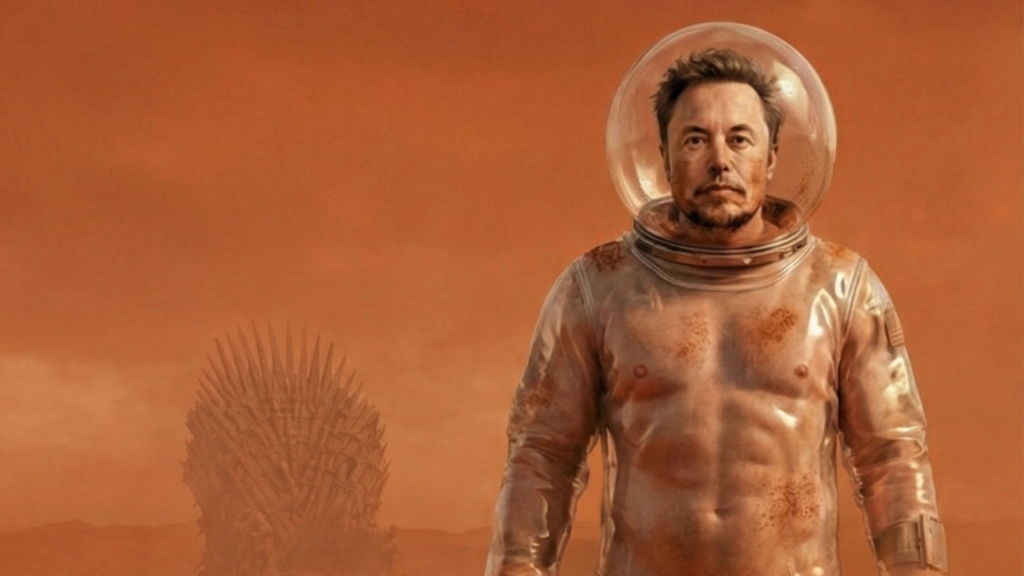
Mar
Once upon a time — specifically, in the first quarter of 2026, in a kingdom called Silicon Valley where the streets were paved not with gold but with something considerably more volatile — there lived a Tech Emperor, whose name, must-not-be-named.
The Tech Emperor, You-Know-Who, was, by any measure, extraordinary. He had built electric carriages that people bought not because they were the cheapest carriages or the most reliable carriages but because owning one meant you believed in something. He had built rockets — real rockets, actual rockets, rockets that went up and came back down and went up again, which nobody had managed to do before and which was, genuinely, a remarkable thing. He had bought the kingdom’s most important town square — a vast, noisy, chaotic piazza where everyone from presidents to plumbers came to shout their humble opinions into the void — and he had renamed it and adjusted the acoustics so that his own voice carried further than anyone else’s. He was, in the specific register of the age, a Visionary.
You-Know-Who had a dream. The dream was Mars. Mars colonization to be precise. He had spoken of this dream for twenty years, with the specific, unblinking conviction of a man who has decided that saying a thing often enough and loudly enough is a form of making it true. He had shown diagrams of the Mars city. He had named the rocket that will take everyone to the new heaven. He had given interviews in which he described, with the calm certainty of someone reading from a schedule, the timeline for human arrival on the red planet.
The people loved him for the dream. The dream was the product. The rockets were how the dream was delivered. The town square was where the dream was amplified. The electric carriages were what the dreamers drove to the launch site. Everything connected. Everything served the dream.
And then, one day, two men arrived at the palace gates.
***
They were, by their own description, the finest suit-makers who had ever lived. Their names were Goldman and Sachs — no obvious relation to the investment bank, they were very clear about this, though they did have the bank’s phone number in their contacts and had used it recently just prior to entering the palace gates — and they came bearing references from the most powerful venture capital firms in Silicon land, letters of introduction from sovereign wealth funds, and the specific, warm-voiced confidence of people who have spent their entire careers making things sound more reasonable than they are.
“Your Imperial Majesty,” said Goldman, bowing deeply, “we have heard of your great dream. The rockets. The town square. The electric carriages. The red planet. And we have come to offer you a suit worthy of it.”
“Not just any suit,” said Sachs, also bowing, slightly deeper, slightly exaggerated, because he billed at a higher hourly rate and felt this should be physically expressed. “A suit of such extraordinary value, such unprecedented construction, such visionary tailoring, that any man who wears it will be immediately recognised as the most important person in the history of civilisation. More important than the man who owned all the petrol. More important than the African Emperor who owned all the gold. The first trillionaire. The history books will not merely mention you. They will open with you.”
You-Know-Who raised an eyebrow. He liked being the most important person in the history of civilisation. He had been working toward it.
“What is the suit made of?” he curiously asked.
Goldman and Sachs exchanged a glance. It was a glance that contained several things simultaneously: the mutual reassurance of two professionals about to say something that required professional reassurance, the specific calculation of men who have modelled the downside scenario and found it acceptable, and the very faint flicker of something that — in a different light, in a more honest room — might have been called a cheeky wince.
“It is made,” said Goldman, “of the finest narrative threads in the known universe. Spun from satellite internet subscriptions. Woven with the silk of artificial intelligence. Embroidered with the thread of orbital data centres. Lined with the velvet of US government contracts. And finished — ” here he paused, for effect, the way people who charge for effects always pause — “finished with the gold leaf of Mars.”
“It is completely invisible,” added Sachs, helpfully, “to anyone who is not sophisticated enough to understand the valuation.”
You-Know-Who looked at the space where the suit apparently was.
“How much?” he said.
“One point seven five trillion dollars,” said Goldman.
“That is,” said You-Know-Who, “a great deal of money.”
“It is,” agreed Goldman. “It is, in fact, the largest amount of money ever paid for a suit in the history of tailoring. Which is exactly how you know it is the right suit. Lesser men wear lesser suits. You, Your Majesty, require the suit that has never existed before. The suit that redefines what a suit is. The suit that makes every previous suit look like fancy dress.”
You-Know-Who looked at the space where the suit was again.
He could not see anything.
This concerned him slightly. He was a sophisticated man. The smartest man on the planet. Real life iron-man. He understood technology, finance, orbital mechanics, the regulatory framework of the Federal Communications Commission, and the precise algorithm that governed what appeared at the top of his own town square. He was not, by any measure, unsophisticated. And yet the suit appeared to consist entirely of air, which was not a material he had previously associated with garments priced at one point seven five trillion dollars.
But Goldman and Sachs had said it was invisible to the unsophisticated. And You-Know-Who had built rockets. He had disrupted automotive manufacturing. He had purchased and renamed a town square. He was, he was fairly certain, one of the more sophisticated people in any room he had ever entered. And he too, had got his companies valued at billions of dollars based on nothing. These were his kind of people.
If he said he could not see the suit, it would mean he was not sophisticated. And if he was not sophisticated, the banks that had lent him the money to buy the town square — money they needed to get back, and which required him to remain the kind of person banks lent money to — would begin to ask questions.
“The workmanship,” said the Emperor, “is extraordinary.”
***
The tailors set up their looms in the palace. The looms were very large and made of very expensive metal and hummed in a way that suggested significant computational activity. They were, the tailors explained, currently processing the xAI integration, the Starlink subscriber projections for Q3 2027, the orbital data centre feasibility model, and the government contract renewal assumptions under three different post-2028 electoral scenarios.
The Tech Emperor sent his advisors to check on progress. He was eager to know how it was all going.
The first advisor was the Chief Financial Officer, a man who had a doctorate in quantitative finance from a very good university and who had spent thirty years telling powerful people things they did not want to hear with the specific, diplomatic phrasing that ensured the things were heard without the messenger being shot.
He looked at the looms. He looked for the suit. He saw the looms. He saw Goldman. He saw Sachs. He saw a very sophisticated deck with charts that went up and to the extreme right.
But, he could not see the suit.
“As you can see,” said Goldman, gesturing at the air above the loom with the confidence of a man gesturing at something that is definitely there, “the xAI component alone justifies a $250 billion valuation when you apply the forward revenue multiple of comparable AI companies at the same stage of their development curve, adjusted for the synergistic Starlink distribution advantage and the regulatory tailwinds from the current administration’s space policy priorities.”
The CFO looked at where the $250 billion valuation of xAI was being sewn into the suit.
He had seen Grok’s market share numbers. He had seen ChatGPT’s market share numbers – more than 800 million users. He had opened both in the same browser window and compared them in the way you compare things that are not the same size. He was aware that “comparable AI companies at the same stage of their development curve” was a phrase that could be used to mean almost anything, depending on which companies you selected and which stage you decided you were at.
“The workmanship,” said the CFO, “is absolutely exceptional.”
He went back to the Tech Emperor and said the suit was coming along beautifully.
The second advisor was the Head of Investor Relations; a woman whose entire professional identity rested on her ability to tell the market a story that the market wanted to hear without technically saying anything that the SEC could classify as a material misstatement. She was very good at her job.
She looked at the looms. She looked for the suit. She could not find the suit.
“The Starlink section of the suit,” said Sachs, pointing at the lining that was not there, “incorporates our proprietary weather-adjusted subscriber retention model, which accounts for signal degradation under extreme adverse atmospheric conditions by applying a churn discount to the rain-affected geographies, offset by the premium ARPU of markets where fibre infrastructure has not yet reached the density required for competitive displacement. The net effect, as you can see — “
She could not see the net effect.
She had, however, seen the subscriber numbers for Western Europe. She had seen the rain data. She had, in a previous role, worked on a telecoms valuation where the same weather-adjusted subscriber retention model had been applied to a satellite broadband company and had produced projections that the subsequent three years of actual weather had found very optimistic. She had also seen who the underwriting banks were and was aware of what they were owed by the Tech Emperor from the town square acquisition.
“The lining,” said the Head of Investor Relations, “is particularly fine.”
She went back to the Tech Emperor and said the suit would be ready for the roadshow.
***
The roadshow was spectacular.
Goldman and Sachs dressed the Tech Emperor in the suit in front of an audience of institutional investors, sovereign wealth funds, retail brokerage platforms, financial journalists, and the three biographers who were already under contract for The Trillion Dollar Man (Goldman Sachs, publisher TBC, Netflix documentary rights under discussion). The Tech Emperor stood very straight and wore the suit with the specific, absolute conviction of a man for whom acknowledging that the suit was not there was not an available option.
“You can see,” said Goldman, to the room, “how the suit fits perfectly across the shoulders of the xAI integration. The cut of the Starlink revenue projection is impeccable. The orbital data centre embroidery, while not yet visible to the naked eye, will become apparent to the sophisticated investor with a three-to-five-year horizon or beyond. The US government contract lining is, of course, guaranteed — “
“For the duration of the current administration?” said a voice from the back of the room.
Silence.
Everyone turned.
It was a child. A British-Zimbabwean, judging by the accent, which had the particular, specific quality of someone who has been living in London long enough to acquire a second cadence without losing the first. The child appeared to have wandered in from the street, bypassed the security, located an empty seat in the back row of the most consequential IPO roadshow in the history of capital markets, and was now looking at the Tech Emperor with the expression of someone who has genuinely tried to find the suit and cannot.
“For the duration of the current administration?” the child said again. “What happens to the contracts if there’s a different administration? What happens to the $250 billion Grok valuation when you compare it to Grok’s actual market share? What is the weather-adjusted subscriber retention number in markets where it rains a hundred and fifty days a year? When do the orbital data centres — “
“The child,” said Goldman harshly, then smoothly, “does not understand the valuation methodology.”
“The child,” agreed Sachs, “lacks the sophistication to appreciate the synergistic — “
“I can see that the Tech Emperor is NAKED,” shouted the child.
The room was very quiet.
The Tech Emperor looked down.
He looked at the space where the suit was supposed to be.
He looked at the child.
He looked at Goldman and Sachs, who were looking at him with the expression of men who have already charged the tailoring fee and consider the remainder of this proceeding to be, technically, not their problem anymore.
He looked at the institutional investors, who were looking at him with the expression of men and women who had committed to their allocations and could not now uncommit without explaining to their own clients why they had committed to something that a British-Zimbabwean child had identified as invisible.
He looked at the biographers, who were looking at him with the expression of people who had already written the chapter where the suit was magnificent and found the prospect of rewriting it professionally inconvenient.
He looked at the town square — at the screens on the wall showing the real-time feed from his own platform, where the bots and the fanboys were already reporting that the suit was, in fact, worth $175 trillion minimum, and the haters just didn’t get it.
The Tech Emperor straightened his back.
“The suit,” he said, “is extraordinary. The child is unsophisticated. We proceed.”
The procession began.
The people at the sides of the road cheered. Not all of them could see the suit. Most of them, if pressed, would have admitted they could not see the suit. But the people who had said they could see it were people who had built careers, investment portfolios, loan books, and biographies on the suit being there, and the people who had said they could not see it had been explained to, firmly and repeatedly, that this reflected poorly on their sophistication.
The child watched the procession go by.
“He’s not wearing anything,” the child said, again, to no one in particular, or to anyone in particular, or to whoever happened to be reading this.
“I know,” said the person next to the child.
“Then why is everyone — “
“Because,” said the person next to the child, gently, in the way you explain things to children when the explanation is something you would rather not have to make, “when the music stops, they want to already be sitting down.”
The child thought about this.
“What about the people buying the SpaceX IPO?”
“They’re not in the room,” said the person.
“Oh,” said the child.
The procession turned the corner. The rockets gleamed in the afternoon sun. The Starlink dishes caught the light. The orbital data centres, invisible from this altitude, were presumably up there somewhere, getting ready. The first trillionaire in the history of human civilisation waved at the crowd from inside his suit.
It was, by all accounts, a magnificent suit.
The tailors, Goldman and Sachs, were already on a plane.
***
There is a scene in Hans Christian Andersen’s famous story that nobody talks about enough. Not the moment the Emperor walks out naked — that is the famous bit, the bit everyone knows, the bit that gives the story its title. The moment nobody discusses is the one that comes before it: the moment the courtiers see the empty loom, see the bare skin of their Emperor, understand exactly and completely what is happening — and say absolutely nothing. Zilch. Kaput.
They do not say nothing because they are stupid. They are, many of them, highly educated, politically experienced, professionally sophisticated individuals who have spent their careers reading rooms, assessing situations, and adjusting their public positions accordingly. They say nothing because they have done the calculation. The calculation is simple. If the suit is real and they say it is not there, they are fools. If the suit is not real and they say it is there, they survive until the next person says it is not — and they are betting that person will not be them.
The courtiers who dressed the Emperor, the courtiers who admired the progress of the garment, the courtiers who accompanied him through the streets with the expression of men attending the unveiling of a masterpiece — these people were not deceived. They were incentivised. There is a difference. The deceived person says: I didn’t know. The incentivised person says: I couldn’t afford to know.
I want you to hold that distinction in your mind as we discuss the SpaceX IPO.
***
Let me be honest with you from the beginning. Sort of.
I am not a Wall Street analyst. I do not have unfettered access to a $20,000 per year Bloomberg terminal, a Reuters subscription, or a background in financial modelling of any kind. I do not have access to the confidential briefing that presumably exists — the one in which Elon Musk showed the institutional investors the real numbers, the ones they cannot put in the prospectus because they are simply too large for ordinary human comprehension. I have not been shown the hidden xAI revenue figures that explain how an AI chatbot nobody uses became worth $250 billion overnight. I have not been briefed on the secret Mars timeline — the real one, the one beyond the public one, the one that makes the $1.75 trillion look, as Musk’s own followers on X will tell you with the serene confidence of people who have achieved perfect enlightenment, like an absolute bargain. Not $1.75 trillion. SpaceX should be worth $175 trillion, minimum. His most devoted followers say this with straight faces. On a platform he owns. Amplified by an algorithm he controls. Through accounts whose humanity status remains, let us say, contested.
I am just a child at the side of the road, watching the procession.
And the Tech Emperor is naked.
He is, however, wearing a very expensive suit. A Gucci space suit, semi-transparent, tailored by the finest financial engineers that $300 billion of personal net worth can assemble, stitched together from rocket fuel and satellite internet and a chatbot and a social media platform and a concept called “orbital data centres” that exists, currently, as the last slide in a presentation. The suit is extraordinary. Everyone who has been invited to touch it says so. The banks say so. The technology media says so. Tim Urban — who wrote the definitive Musk hagiography, the essay that inoculated a generation against scepticism by making scepticism feel like a failure of imagination — will say so, probably in a new book, probably with a Netflix deal already signed, because when the first trillionaire in human history is assembling his suit, you do not want to be the biographer who missed the fitting. Walter Isaacson, who sat next to Musk for a year and produced a portrait that the subject apparently found insufficiently flattering, is presumably already revising his position. The suit is on. The cameras are on. The IPO roadshow is about to begin.
I am just a child. I do not understand the suit. I am sure there is a perfectly reasonable explanation for all of this.
I just cannot find it.
***
The Audience That Cannot Afford to Boo
Let us begin with the people in the room, because the people in the room tell you everything about the act being performed.
The banks that will underwrite the SpaceX IPO are the same banks that lent Elon Musk the money to buy Twitter — a $44 billion acquisition that immediately destroyed approximately $30 billion of its own value, that drove away the advertisers it depended on, and Elon told them to ‘F*ck off’ for good measure, then he renamed Twitter to X and spent two years demonstrating that a social media platform is essentially nothing without the users it managed to alienate, and that is currently valued at roughly a tenth of what was paid for it. Those banks are sitting on huge losses. Those huge losses require a story. The story requires a next chapter. The next chapter is the SpaceX IPO, in which the banks that underwrote the disaster become the banks that underwrite the recovery, and in doing so recover something from the financial wreckage. They cannot say the suit is not there. They have already charged for the tailoring.
The technology journalists who will cover the IPO with the breathless enthusiasm of people who have never met a number they couldn’t make exciting are the same technology journalists who covered every previous Musk announcement with the same breathless enthusiasm. They have spent a decade building audiences on the back of his narrative. Their blogs, newsletters, their podcasts, their Substack growth curves are partially Musk-shaped. The Musk announcement is engagement. The Musk criticism is also engagement, but it is a different kind — the kind that gets you quietly removed from the press list, quietly uninvited from the launch event, quietly excluded from the access that makes technology journalism possible in the first place. They cannot say the suit is not there. The suit is their distribution strategy.
The retail investors who will buy the IPO on day one are the same retail investors who bought Tesla at $400, watched it go to $1,200, rode it back to $200, watched it climb again, and have been explaining to their partners and their friends and their financial advisors for the better part of a decade that Elon Musk is different, that the rules do not apply to him, that the valuation is not the point, that you simply have to believe in the man. They have staked their self-image on the correctness of this position. They cannot say the suit is not there. The suit is their entire identity.
And the advertisers who left X after it became a place where the content moderation had been gutted, the bot accounts had multiplied, the reach had fallen, and the CEO had personally endorsed positions that made their brands uncomfortable being adjacent to them — those advertisers will return. Not because X has fixed the problems. But because the man who owns X is about to be worth, on paper, somewhere north of a trillion dollars, and there is a specific, primal, deeply human instinct in every marketing director on earth that says: you do not want to be the person who is not on good terms with the richest person who has ever existed. They will say the suit is extraordinary. They will buy the advertising packages. They will attend the event.
This is the audience for the SpaceX IPO. Not a single person in it can afford to see what is in front of them.
All of which means it falls to the rest of us.
The Laundrette — A Pattern Recognition Exercise
Before we get to the specific absurdity of a $1.75 trillion valuation, let us establish the pattern. Because without the pattern, this looks like an ambitious but plausible corporate restructuring. With the pattern, it looks like what it is.
In 2023, Musk announced that unless Tesla shareholders granted him a new compensation package worth approximately $56 billion — a package that would dwarf the GDP of several nations and represented the single largest executive compensation award in corporate history — he would develop artificial intelligence “elsewhere.” Not at Tesla. Elsewhere. The implication: Tesla’s AI and autonomy ambitions, which were a significant component of Tesla’s valuation premium over ordinary car companies like Toyota and Ford, would depart with him if he did not receive the money. He was not threatening to leave. He was threatening to take the story with him. And the story, in Tesla’s case, was worth more than the cars.
He received the compensation package. The Delaware courts subsequently and reasonably voided it. He received it again from a different jurisdiction. This is a detail worth filing.
xAI was founded in 2023. By 2024 it was valued at $50 billion. By mid-2025 it was valued at $80 billion. In February 2026, SpaceX acquired xAI in a share exchange valued at $1.25 trillion combined. xAI’s implied value in the deal: approximately $250 billion. The increase in xAI’s value between its last independent funding round and its SpaceX merger: somewhere between $170 billion and $200 billion, depending on which numbers you use.
What changed? What product shipped? What market share was won? What capability was developed that did not exist before? Definitely not AGI.
Grok, xAI’s AI assistant, currently holds a small fraction of ChatGPT’s user base. It runs, primarily, on X — a platform whose own user numbers are contested, whose advertising revenue has collapsed from approximately $5 billion annually before Musk’s acquisition to somewhere between $1.5 and $2 billion after. The product at the centre of the $250 billion valuation increase is an AI chatbot that fewer people use than its three main competitors, running on a platform whose primary growth mechanism is being the place you go to argue with bots.
And then SpaceX acquires it. And the combined entity is valued at $1.75 trillion and scheduled for a June 2026 listing.
This is the laundrette. The failing asset enters. The credible asset receives it. The combined entity is valued not at the sum of its parts but at something significantly larger than either could justify alone, on the basis of a narrative about the synergies between them that has not yet been demonstrated to exist in any product that any customer can buy. You wash the asset through the narrative. It comes out clean. You sell it before the wash cycle finishes and the original stains reappear.
The Number That Should Stop You
Before we go further, let us do the arithmetic that nobody in the SpaceX IPO roadshow is going to do in a room with investors.
SpaceX generated $15.5 billion in revenue in 2025. It is going to be offered to you at $1.75 trillion. That is a revenue multiple of approximately 113 times.
Let us put that in context. Amazon, at its most exuberantly valued, traded at 4 times revenue. Google — the search company that prints money at a scale that makes other companies embarrassed to describe their own operations — trades at roughly 6 times revenue. The most generously valued AI companies in 2026, the ones trading on the promise of future dominance rather than current earnings, trade at 20 to 30 times forward revenue.
One hundred and thirteen times.
Not forward revenue. Current revenue. Revenue from a business that is, at its core, a satellite internet service and a rocket launch operation on behalf of a government, its sole big customer. A satellite internet service whose performance degrades by between 38% and 52% in rain. A rocket launch operation that currently derives the substantial majority of its non-Starlink income from contracts with the United States government.
But here — let us be generous. Let us grant the orbital data centre vision. Let us grant the AI integration. Let us grant every promise in the prospectus and ask a simpler question: what would need to be true for this valuation to make sense?
What Would Need to Be True
For the SpaceX IPO to justify $1.75 trillion — for the people buying it on day one to see their money grow rather than evaporate in the way that money tends to evaporate when it is paid for things at 113 times their revenue — a very specific set of things would need to happen. Not eventually. Not theoretically. Within the investment horizon of the people writing the cheques.
Shall we go through them?
Scenario One: Grok becomes the world’s dominant AI chatbot.
Everyone — and I mean everyone and their dog and grandmother — would need to abandon ChatGPT, Claude, Gemini, Qwen, and DeepSeek and flood toward Grok with the conversion enthusiasm of people who have just received an epic revelation. The 800 million users currently in OpenAI’s ecosystem, the enterprises that have built their workflows around Claude’s code capabilities, the developers who have integrated Gemini into their applications, the cost-conscious users who discovered DeepSeek and Qwen and could not believe the price-to-performance ratio — all of them would need to look at Grok and decide that this, specifically, was the product they had been waiting for all along.
Grok would need to be adopted by governments. Not one government — governments, plural. Heads of state would need to migrate their intelligence briefings, their policy analysis, their national security infrastructure onto a platform owned by a man who simultaneously owns the primary social media platform on which those governments are being criticised, the satellite infrastructure those governments depend on for communications, and the rocket systems those governments use for defence and scientific launches. They would need to find no conflict of interest in any of this. They would sign the contracts without lawyers present.
Grok would need to win the enterprise. The CIOs of the Fortune 500, currently deep into their Claude and Copilot integrations, having spent significant capital on change management and retraining and API architecture built around OpenAI’s specifications, would need to rip it all out and do it again for Grok. On the basis of a product that, as of March 2026, is not leading any independent benchmark in any category that enterprise buyers have indicated they care about.
For the xAI component of this valuation to make sense, you need to believe that Grok is going to do what WhatsApp did after Facebook acquired it, what Instagram did after Facebook acquired it, what YouTube did after Google acquired it — that the acquisition unlocks a trajectory of growth that the acquired company could not have achieved independently, and that the combined entity becomes so dominant in its market that the acquisition price looks, in retrospect, like a bargain.
WhatsApp had 450 million monthly active users when Facebook acquired it. YouTube had 800 million monthly views. Instagram had 30 million users growing at 100% year-on-year. What does Grok have? A smaller user base than its third-ranked competitor, growing more slowly than the market, running primarily on a platform whose own growth story is at best contested. Grok is slightly better than Meta’s Llama and that is no way a compliment. The pattern is not the same. The conclusion drawn from it is the same. This is where being smart gets expensive.
Scenario Two: The world abandons fibre for Starlink.
Every household in Western Europe — in Britain, in Germany, in France, in the Netherlands, in the Scandinavian countries that have built some of the most comprehensive fibre broadband networks on earth — would need to look at their gigabit fibre connections, look at the Starlink dish on their website, and decide to switch immediately. Mind you, in Europe, they are already used to receiving their entertainment via Sky satellite dishes, so why not internet too. This is not because the fibre stopped working. Not because Starlink got dramatically cheaper. But because the orbital internet is simply so much better that the choice becomes obvious.
In Manchester, in the UK, where my Aunt and Uncle lives, and I rarely visit because of the weather – it rains approximately 140 days a year, residents would mount Starlink dishes on their rooftops and accept that for 38% to 52% of rain events their internet would degrade measurably, because the rest of the time the experience was worth it over the gigabit fibre they had before. In Amsterdam, in the Netherlands, one of the most connected cities on earth, residents would reach the same conclusion. These are the same folks whose ancestors invested during the tulip mania, so anything goes in the orange district light.
In rural Africa — in the townships and the farming communities and the places where the alternative was genuinely nothing, or something so close to nothing that even a rain-degraded Starlink signal was transformative — Starlink would continue to grow. This part is real. Starlink’s African growth is one of the genuine, non-narrative achievements of the business. The problem is the economics: the markets with the sun do not have the money, or precisely, US dollars, and the markets with the money have the rain and already have the fibre. The financial model of the world’s most valuable company cannot be built on rural Zimbabwe. This is not a criticism of rural Zimbabwe. It is just basic arithmetic, like the ‘basic’ in universal basic income.
For the Starlink component of this valuation to make sense, you need to believe that the total addressable market (which tech startups fervently refer to as TAM as if it’s their special toy that gives them superpowers) for satellite internet at premium ARPU levels is larger than it actually is, in geographies that are more favourable than they actually are, at churn rates lower than they will actually be as fibre infrastructure in developing markets improves, as the physics of signal degradation in adverse weather remains exactly as inconvenient as it currently is.
Scenario Three: The United States government becomes exclusively, permanently, and increasing intensely committed to Moon colonisation via SpaceX, regardless of who is in the White House.
Forget the on-off bromance between Elon Musk and Donald Trump. The US Space Force, NASA, the Pentagon, and every agency that currently awards launch and communications contracts would need to decide — as a matter of institutional policy rather than political relationship — that SpaceX is the only viable partner for national space ambitions. Not one of several. Not the preferred contractor in competitive tenders. The one. The only one.
This would need to remain true after 2028. After an election in which the current administration’s policies are reviewed, its relationships are audited, and its preferential contracting arrangements are examined by people who were not the beneficiaries of them. Boeing, Northrop Grumman, Lockheed, Blue Origin — all of them would need to remain permanently uncompetitive with SpaceX not because their technology is inferior but because the market had simply decided, conclusively and irreversibly, that one provider was sufficient for the national security space infrastructure of the world’s largest military power.
Governments, as a rule, do not do this. Especially the US government. Maybe some African and Asian governments if they got some kickbacks and favourable coverage on X. But definitely not the US Government. The US government, maintain multiple suppliers for strategic capabilities for the same reason you do not put all your data on a single server: not because you distrust the single server, but because you cannot afford to discover what happens if you were wrong about the trust.
For the US government contract component of this valuation to make sense, you need to believe that a political relationship is an institutional one, that a preference is a policy, and that the contracts that flow from a specific and documented personal relationship between the company’s owner and a specific administration will continue to flow regardless of who holds that administration’s offices after the next election. In the history of US government contracting, this has never been true. There is no reason to believe 2028 will be the first exception.
Scenario Four: The orbital data centre works.
Somewhere in the $1.75 trillion number is the value of a concept that does not yet exist, built on technology that has not yet been space-hardened, providing a service whose latency characteristics make it structurally unsuitable for the most latency-sensitive AI workloads, at a cost per kilowatt of delivered energy in low Earth orbit that is currently several orders of magnitude higher than terrestrial alternatives.
For the orbital data centre to justify its portion of the valuation, you need to believe that SpaceX will solve, within the investment horizon, the radiation hardening problem, the latency problem, the cost-of-energy problem, and the maintenance-in-orbit problem simultaneously — and that when they do, the resulting product will be so superior to terrestrial alternatives that the market will pay a premium for it rather than simply continuing to use the data centres that are already built, already powered, already networked, and already priced at something resembling an accessible unit cost.
You would also need to believe that the timeline for this is closer to the IPO than to the original Mars colonisation timeline — which was, you may recall, 2024. The man who told you we would be on Mars in 2024 is now telling you we should do the Moon first, and has placed at the centre of his $1.75 trillion valuation a product category that currently exists as a concept in an investor presentation.
Put all four of these scenarios together. Assign each a probability. Multiply them together. The result of that multiplication is the probability that the $1.75 trillion valuation is justified.
I will leave the arithmetic to you. I find I am too old to do maths that makes me this sad.
The Hypocrisy Audit
Every article in which a Tech Emperor appears must contain the hypocrisy audit. What does he preach? How does he live?
Musk preaches the democratisation of space. He preaches that his mission is the survival of human civilisation, the multiplanetary future, the long arc of the species rescued from its terrestrial fragility by the courage and the vision of private enterprise unshackled from the bureaucratic lethargy of government agencies.
He has just put Mars on hold.
Not quietly. Not in a footnote. Publicly on twitter (I mean X), in the context of a Moon-first pivot that places SpaceX’s primary celestial ambition directly inside the NASA Artemis programme’s budget cycle and political calendar. The romantic narrative — the one that made engineers take pay cuts to work there, that made millions of people feel that SpaceX was something more than a contractor, that this was a company with a mission rather than a market position according to Tim Urban — has been adjusted to fit the government contract that is available right now, from this administration, in this political moment.
The mission was always the story. The contracts were always the business. The story has now been adjusted to match the contracts, because the contracts are what the $1.75 trillion is actually built on, and the story needs to be credible enough to keep people from noticing.
Musk preaches that the future belongs to the bold, to the people who ignore conventional wisdom, to the entrepreneurs who move faster than the institutions. He has spent the last eighteen months acquiring government influence, government contracts, and government adjacency with the specific, methodical patience of a man who has realised that the boldest move available is simply to become so embedded in the institutional structures he claims to transcend that the institutions cannot remove him without removing themselves.
He preaches free speech and the open internet. He owns the platform and adjusts its algorithm. He preaches that Twitter — X — is the town square of the world. He banned journalists. He preaches that the market should decide. He has positioned himself so that the market deciding against him has regulatory and contractual consequences for the decision-makers. Free markets, in this model, are markets that are free to agree with him.
This is not new behaviour. It is the behaviour of every Emperor who has ever understood that the most durable power is not the power to force compliance, but the power to make compliance feel like agreement. The courtiers are not ordered to admire the cloth. They simply understand, with the perfect clarity that self-interest provides, that admiring it is better for them than not admiring it.
The Tesla Precedent — What the Kool-Aid Actually Costs
Let us talk about Tesla for a moment, because Tesla is the case study, and the case study is instructive.
In 2020, Tesla was added to the S&P 500. It was, at that point, valued higher than Toyota, Volkswagen, Ford, and General Motors combined — companies that, collectively, manufactured approximately 50 times as many vehicles per year as Tesla. The justification for this valuation was not the cars. It was the software, the autonomy, the energy business, the narrative of a company that was not really a car company but a technology company that happened to make cars. Full self-driving (FSD, which rather sounds like an alternative name for Ketamine) was imminent. The robotaxi fleet was coming. The energy storage business was about to change the grid. The premium multiple was not for what Tesla was. It was for what Tesla was going to be.
Full self-driving was announced in 2016. As of 2026, it remains in supervised release, requiring driver attention, generating incidents that its own data logger documents, operating under regulatory restrictions in most markets that prevent the autonomous operation it was sold as enabling.
The robotaxi fleet was promised by 2020. It launched in limited form, in limited cities, in 2024, at a scale and with a unit economics that its competitors — Waymo, principally — find comfortable to compare publicly with their own operations, and not in Tesla’s favour.
The stock, having hit a multiple that valued it at more than the entire rest of the global automotive industry, fell by approximately 75% from its peak before recovering partially on the back of the political relationship between its CEO and the current US administration, which generated regulatory tailwinds and federal adjacency that the market interpreted as a competitive moat.
Let’s not beat about the bush here, Tesla is a memestock. Its CEO is its primary content creator. Its valuation is a function of narrative momentum and retail investor conviction rather than fundamental analysis. This is GameStop all over again. There is so much dumb money out there people!
By the way, this is not an insult to Tesla’s engineers, who build a product many biased people find genuinely excellent. It is an observation about the relationship between the product and the price, and about the specific mechanism by which the price has been maintained.
The people who bought Tesla at $400 and held through the drop and the recovery are not wrong that they made money. Some of them made extraordinary money. They are also not the people the next iteration of this trade is designed for. The next iteration is designed for the person who looks at the Tesla chart and sees validation of the thesis — who concludes that because Tesla survived, SpaceX will too, that because the Kool-Aid was profitable last time, it is safe this time. This is a category error dressed as investment strategy. Lightning does not strike the same place twice by design. It strikes the same place twice when you build the lightning rod in the same spot and tell yourself it is the spot that matters rather than the rod.
The Insider Selling Question
There is a question that every prospectus is legally required to answer and that every IPO investor is rationally obligated to ask: who is selling?
When a company goes public, some of the money raised goes to the company for future investment. Some of it goes to existing shareholders who are using the IPO as the mechanism for converting their private ownership into public liquidity. The people selling in the second category are, by definition, people who have decided that $1.75 trillion — the public market price — is a better price for their shares than any price they could get by holding.
These are the people who know the most about the company.
When the people who know the most about the company decide that the public market price is the right moment to sell — when they conclude that the story, at this specific valuation, at this specific moment, is best realised in cash — the question the retail investor should be asking is not whether the story is compelling. The question is whether the story is more compelling than the return on holding.
I do not know who is selling in the SpaceX IPO, because the prospectus has not been published at the time of writing. I know that this is the question whose answer will tell you more about the investment than any pitch deck about orbital data centres.
When the bankers call you — and they will call you, with their warm voices and their revenue multiple decks and their TAM analyses and their slide about the number of potential Starlink subscribers in markets SpaceX has not yet entered — ask them: who is selling, and at what terms, and why now?
Then watch what they do with the question.
The Moon Pivot: When the Story Needs a Rewrite
In a move that the enthusiast press has covered as a “strategic evolution” and that a literary critic would recognise as the moment the author realises the original ending is not going to work at all, Musk has announced that the Moon comes before Mars.
Let us be precise about what this means.
It means that the narrative asset — the thing that separated SpaceX from every other defence contractor and satellite operator, the thing that made it a mission rather than a business, the thing that gave its employees a reason to work the hours they work at the compensation they receive when comparable talent in other sectors earns significantly more — that narrative asset has been quietly adjusted to align with the available US government programme.
The available government programme is Artemis. Artemis is NASA’s Moon programme. Artemis has a budget. Artemis has a contractor list. Artemis needs a heavy launch vehicle. SpaceX has Starship. The alignment is real. The money is real. The contract is real.
But the narrative that justified the valuation was Mars. The narrative that made SpaceX into something a generation of young engineers chose over Google, over Apple, over companies that paid better and demanded less — that narrative was interplanetary civilisation. Moon colonisation is not interplanetary civilisation. Moon colonisation is a US government programme with a political calendar and a Congressional budget cycle and an expiry date tied to the administration that funds it.
When the story needs a rewrite in the middle of an IPO roadshow, one of two things is happening. Either the original story was wrong — in which case the valuation built on it is wrong — or the original story was right but the timeline is longer than the investment horizon — in which case the valuation built on the near-term version of it is wrong.
Either way, you are being asked to buy the confidence of the rewrite rather than the evidence of the original thesis. This is a specific kind of intellectual courage that the investment community has a specific name for. They call it risk. They also call it, when it works out, vision. And they call it, when it does not, what it was all along.
The Fanboys in the Parade
I want to be specific about the people carrying the train of the Emperor’s new suit, because they deserve their moment in the absurd chronicle.
Tim Urban wrote The Elon Musk essay for his blog, Wait But Why in 2015 — a 40,000-word masterpiece of enthusiast journalism that did for Musk’s public image what the Book of Genesis did for the concept of creation: it provided the foundational text from which all subsequent devotion could be calibrated. Tim Urban is an extraordinary writer. The essay is genuinely compelling. When it was published, and I randomly discovered it, while learning about first principles thinking, I read it at least 5 times. And considering its length, that is some achievement! Or so I told myself at the time. It is also, in retrospect, the intellectual Kool-Aid dispenser for a generation of people who subsequently found it very difficult to update their priors when the evidence suggested updating would be appropriate. Tim Urban, I suspect, is not writing a critical reassessment of the SpaceX IPO. Tim Urban is, I further suspect, writing something that will help people understand why the valuation is not just justified but inevitable — why doubting it is, in the specific register of the Wait But Why universe, a failure to think at the right timescale.
Walter Isaacson spent a year embedded with Musk and produced a biography that Musk found insufficiently hagiographic — which tells you something interesting about what hagiography looks like to a subject who believes the truth about him is already extraordinary. Isaacson will not be saying the suit is not there. Isaacson has a relationship, a reputation, and a publisher whose enthusiasm for a Second Act: The Trillion Dollar Man is, I would estimate, already considerable.
Netflix is, if there is justice in the universe of IP acquisition, already in conversation with someone’s agent about The First Trillionaire — a documentary series, four episodes, produced with the intimate access that access journalism requires and the critical distance that access journalism tends to preclude. It will be excellent television. It will make 140 million people feel that they understand Elon Musk without needing to share passwords and having watched some ads. It will be released approximately six months after the IPO, when the stock is either performing or not performing, and the framing of the narrative will have been adjusted accordingly.
None of these people are stupid. None of them are, in any simple sense, corrupt. They are incentivised. The distinction, as we established at the beginning of this article, matters enormously. The deceived person says: I didn’t know. The incentivised person says: I couldn’t afford to know.
I can afford to know. I have nothing to lose by knowing. This is the specific, underrated advantage of being a child at the side of the road with a satirical tech blog and both a British and Zimbabwean passport and no position in any security mentioned in this article.
The X Factor — Or, The Social Media Platform That Elected Donald Trump, is About to Sell You a Rocket Ship
Here is the thing about owning the megaphone that is X. You know it as Twitter. And even 2 years after the acquisition, we all still call it Twitter.
When Musk acquired Twitter, the most consistent criticism — the one that unified otherwise disagreeing analysts across the political spectrum — was that a social media platform should not be owned by a single individual with active business interests across multiple regulated industries. That the combination of platform ownership and the ability to shape the information environment constituted a conflict of interest that normal people running normal businesses were legally required to disclose and, in many cases, divest.
The criticism was correct. The response was to point at the traffic numbers.
X, or Twitter, take your pick, was used — deliberately, systematically, with the specific efficiency of a man who understands algorithmic amplification better than almost anyone alive — as a tool in the 2024 US election. This is not a partisan claim. It is a documented feature of how the platform operated during the election cycle, acknowledged in the platform’s own internal communications and in the public behaviour of its owner. The result was an administration whose principal occupant has a documented personal relationship with the platform’s owner and whose regulatory and contracting decisions reflect a range of positions favourable to the platform’s owner’s business interests.
Now. The same platform. Controlled by the same algorithm. Populated by the same combination of genuine users, automated amplification accounts, and the specific class of committed true believer whose investment in Musk’s narrative is so total that any new announcement is received as confirmation rather than claim — this platform is about to be deployed in service of the largest IPO in the history of public markets.
The bots will say it should be worth $175 trillion. The fanboys will share the bots. The algorithm will amplify the fanboys. The trending topics will reflect the amplification. The financial media will report the trending topics. The retail investor will see the financial media report and feel the specific, constitutional fear of being the person who did not buy Amazon in 1998, who did not buy Bitcoin in 2012, who did not buy Tesla in 2019 — and they will open their brokerage app when the day of IPO comes.
This is the machinery. You are welcome to stand outside it and observe. I recommend it. The view is clarifying.
The Weather and the Moat
I want to return to the rain, not because I waste my internet data listening to 15-hours of rain sounds on YouTube, but because the rain is where the romance meets the physics, and physics is the adult in the room that nobody on the roadshow has invited.
Starlink’s internet signal uses high-frequency Ku and Ka band radio waves. These frequencies are, by the laws of atmospheric physics that predate Musk’s involvement in the satellite internet business and will survive it, attenuated by water molecules. Rain reduces Starlink throughput by between 38% and 52% depending on rainfall intensity. Heavy cloud cover produces measurably lower throughput than clear sky. This is not a software problem. This is not a firmware problem. This is not a problem that the next generation of satellite hardware addresses. This is the electromagnetic spectrum behaving the way the electromagnetic spectrum behaves when it encounters water, which it has been doing since water existed.
The markets where Starlink has made genuine, meaningful, transformative inroads are markets where the alternative was genuinely terrible — sub-Saharan Africa, rural Southeast Asia, parts of Latin America where fibre infrastructure is decades away from the density required for reliable connectivity. This is real. These are real subscribers whose real lives are meaningfully better for having a connection, even a rain-degraded one, where previously they had nothing. This is SpaceX doing something genuinely worth doing.
These markets pay low Average Revenue Per User. They pay low ARPU because they are, by definition, markets where the population does not have the disposable income to pay high ARPU. This is not a criticism of the people in these markets. It is arithmetic.
The high ARPU markets — the markets that a $1.75 trillion valuation requires, because $1.75 trillion is not a number you support on the subscription revenue of Kenya and Rwanda in East Africa, however real and however growing — are Western Europe, North America, and the Oceanian markets. These are the markets with the fibre. With the gigabit connections. With the data centres already in the ground, the submarine cables already on the ocean floor, the last-mile infrastructure already run to the building. These are also, meteorologically, some of the cloudiest places on earth. The United Kingdom receives rain on approximately 156 days a year. Germany is not the Sahara by the way! Seattle, Washington — where Amazon’s cloud headquarters sits and where the enterprise customers who would pay premium Starlink rates concentrate — is grey for eight months. The Pacific Northwest does not receive weather briefings from someone who has only seen sun.
For the record, since I am anticipating the tweet that will cite subscriber numbers from these markets: yes, Starlink has subscribers in the UK. Some of them are in rural areas where BT Openreach has declined to run fibre and where a slightly rain-degraded satellite connection is still better than the alternative. These are not the subscribers who justify $1.75 trillion. These are the subscribers who justify Starlink being a good, useful, genuinely valued product in a niche that fibre has not yet reached. There is a significant valuation difference between “good product in an underserved niche” and “world’s most valuable company.” The difference is approximately $1.73 trillion, and it is the part of the suit that I am having trouble locating.
The Zimbabwe Dispatch — Or, How to Grab a Continent by the Wallet
I want to tell you something about Starlink that the prospectus will not include, because the prospectus is written by people who have never sat in a house in Harare, in Zimbabwe, watching their chess position collapse not because their opponent outplayed them — because the internet did.
I was born in Zimbabwe. I grew up there. I left at twelve for England, as Zimbabweans of a certain generation did, and I have spent the adult portion of my life explaining to British people that Zimbabwe is not only the country with the famous inflation, thank you, it is also a country with extraordinary food and extraordinary people and an extraordinarily dysfunctional relationship with the technology that the rest of the world has quietly decided is now a human right. I visit regularly — more regularly since my mother, Alice, died in 2022, because grief does what grief does, which is make you want to be in the places where the person was, even when those places are eight hours on a plane from your front door. I sometimes write from Zimbabwe. I sometimes run TechOnion from Zimbabwe. I sometimes write books from Zimbabwe. I am a person for whom the internet is not a convenience. It is the office, the filing cabinet, the distribution network, the entirety of the professional operation. Internet poverty, for me, is not an abstract development metric. It is a personal emergency.
Before Starlink, here is what internet access looked like in Zimbabwe, and specifically in Harare, which is the capital, which is supposed to be the best-connected part of the country, which will give you some sense of what the rural areas are doing.
Econet Wireless. That is the name. Owned by Strive Masiyiwa — a genuinely brilliant man, a self-made billionaire, a Zimbabwean success story of the kind that makes you simultaneously proud and furious, because the success story rests, in significant part, on the specific economic structure of a monopoly in a country where the alternative is nothing. Econet is not exactly a monopoly in the legal sense. It is a monopoly in the practical sense, which is the sense that matters when you are trying to load a webpage. It prints money. It prints money the way Rockefeller printed money from Standard Oil, except the commodity is data, and data, in Zimbabwe — and across most of Africa, and increasingly across the world, though the Western world has not fully processed this yet — is not a luxury. It is food. It is the food of the modern attention economy. You cannot earn without it. You cannot learn without it. You cannot run a satirical blog that holds tech companies to account without it. Data is the new bread, in fact, thanks to Starlink, the new manna from heaven, and in Zimbabwe, Econet bakes the only loaf and charges accordingly.
Two hundred US dollars or more a month for unlimited data. For five megabits per second. Those are the numbers I want you to hold. Not the abstract statement that “data is expensive in Zimbabwe” — the specific, personal, contractual reality of paying two hundred American dollars, which in a country where the median wage is a fraction of what it is in London or New York or San Francisco, is a genuinely significant sum, for a connection that delivers five megabits per second. Not consistently five megabits per second. Five megabits per second when everyone else is sleeping. During the day — during the hours when you are trying to work, when the children are trying to study, when the Zoom call is supposed to be happening — the network is shared among enough concurrent users that the speed drops to something that the Chrome browser’s offline dinosaur game begins to feel like a reasonable alternative.
I have played that dinosaur game more times than I can count. I have broken records on that dinosaur game. I have achieved personal bests on the Chrome dinosaur that represent genuine athletic achievement in the specific sport of being a person with work to do and no internet to do it on. I have watched winning positions on chess.com — positions I had built with patience and care and the specific, calculated optimism of someone who has studied the endgame — collapse not because my opponent played better, but because the internet tapped me on the shoulder, somewhere between my knight’s advance and the clock running down, and said: this is my stop. Enjoy the rest of the game yourself, preferably offline if possible.
The connection simply left. Mid-game. Mid-move. Mid-life.
In the Southern African Development Community (SADC) — the regional bloc of sixteen countries that Zimbabwe belongs to — Zimbabwe pays the most for internet per megabit. It also pays the most for fuel: $2.02 per litre at time of writing, a price that has been climbing with the specific cruelty of a number that affects everything because everything moves on fuel, and the US/Israel vs Iran War has removed any expectation of short-term relief. And — this is the detail that I include not for shock value but because it is the precise, documented, peer-reviewed, Nobel-committee-worthy absurdity that Zimbabwe has somehow managed to achieve — Zimbabwe pays the most in Africa for bread. Not the most in the region. The country that gave the world the $100 trillion note now charges more for a loaf than Nigeria, a country, on my last visit there in 2013, had more people in the capital city of Lagos than the whole of Zimbabwe.
Most expensive internet in the region. Most expensive fuel. Most expensive bread. And then Starlink announced it was coming.
Within two to three days of opening capacity for Zimbabwe, it was oversubscribed. Not slowly oversubscribed, not gradually filling up over weeks as the early adopters trickled in — oversubscribed, immediately, completely, with a waiting list that stretched to a year. Not a year in the sense of “we are very popular.” A year in the sense that Harare — Harare, a city in one of the most economically constrained countries in sub-Saharan Africa — had the longest Starlink waiting list of any major city in Africa. Potentially of any city in the world. Because the alternative was so comprehensively terrible that people who could find the upfront hardware cost would rather have Starlink in a thunderstorm, with the rain attenuation and the cloud interference and the physics doing whatever it is physics does to Ku-band signals at altitude — they would rather have that than give Econet another dollar for another month of the dinosaur game.
Rain? Let it rain. Cloud cover? Point the dish at whatever part of the sky is least hostile and carry on. In Zimbabwe, the signal degradation of a Starlink connection in adverse weather is still, on most days, in most circumstances, a better connection than the clear-sky performance of what the Econet monopoly provides at twice the price. That is the bar. That is the specific, humiliating, entirely avoidable bar that decades of monopoly pricing and regulatory capture have set for what “acceptable internet access” means in that country.
Now. Here is the part of the Starlink Africa story that the IPO prospectus renders in the most optimistic possible light and that I, having been in that waiting list, would like to render in a different one.
The playbook is the oldest one in Silicon Valley. You already know it. But most Starlink subscribers in Zimbabwe don’t. You have seen it with Netflix — free trial, then $8.99, then $15.99, then $22.99, then the password sharing crackdown, then the advertising tier, then the realisation that what was sold as a library is now a rotating rental catalogue and you are paying more for less of it every year. You have seen it with Spotify, with Uber, with every platform that enters a market as a liberator and exits as a landlord.
You enter the market at a price that undercuts the existing monopoly. The existing monopoly — Econet, in this case — has been price-gouging for years and has made itself universally despised in the process. Starlink arrives at a price that, while not cheap by Zimbabwean standards, is cheaper than Econet for better performance. The customers flood in. The waiting list stretches to a year because demand is overwhelming. Competitors — the smaller, local ISPs, the fibre-to-the-neighbourhood startups, the scrappy operators who have been trying to crack the market for a decade — look at the Starlink subscriber numbers and the Starlink pricing and the Starlink hardware cost and make the rational business decision: we cannot compete with a satellite constellation that was funded by American venture capital and subsidised by NASA contracts and operated at a scale that local operators cannot match. They withdraw. They pivot. They close.
And then — not immediately. Not in year one. But in year three, or year five, or whenever the competitive landscape has been sufficiently cleared and the dependency has been sufficiently established — the price goes up. Not dramatically. Not in a way that triggers immediate cancellation. Just enough. Then a little more. Then the next tier. Then the business plan that was predicated on the introductory pricing finds that the pricing is no longer introductory, and the alternative that once existed — the Econet you left, the local operator that closed, the fibre startup that withdrew from the market because it couldn’t compete with the satellite — is gone or diminished, and you are paying, once again, whatever the price setter decides you should pay.
“Grab them by the wallet” is not a phrase I am inventing. It is the business model of every platform that has ever used below-cost pricing to acquire a market before discovering what the market will pay when it has no alternative. The discovery, characteristically, is made after the alternatives have been removed. Donald Trump, in a different context, used a different anatomical reference for the same mechanism. The mechanism is identical: you do not ask for consent. You establish the position first. The consent is retrospective.
In Zimbabwe, Starlink is currently in the early, beloved, genuinely useful, wait-a-year-on-the-list phase. The phase where it has delivered something real to people who needed something real, in a country where the alternative was the Chrome dinosaur and the mid-chess-game disconnection and two hundred dollars for five megabits of shared shame. This is real. I have used it. It is transformative. I say this without irony and without qualification.
But I am also a person who writes about technology for a living, and who has watched this specific playbook run in enough markets across enough platforms across enough decades to know that the word for “Phase One” is not “revolution.” It is “acquisition.” And acquisition, in Silicon Valley as in all other forms of conquest, is always followed eventually by the part they do not put on the billboard.
The rain, as I noted, is not the problem. The problem is what happens when Starlink owns the roof.
The Political Weather
The government contracts. Let us do these quickly, because this is the part of the suit that the prospectus will address in the most careful language available to lawyers who have been paid the most money available to lawyers.
SpaceX holds approximately $22 billion in US government contracts. The Space Force, NASA, the Pentagon’s national security launch programme — these are real contracts, paying real money, for real services that SpaceX genuinely provides with genuine competence. The launches are real. The rockets work. The astronauts arrived at the ISS and came home again. This is not in dispute.
What is in dispute is the durability of the relationship between the contractor and the contracting government beyond the current administration — specifically, whether the volume and value of contracts that flow to SpaceX under the current administration reflects the competitive superiority of SpaceX’s products, or reflects the personal relationship between SpaceX’s owner and the current administration’s principal occupant – Donald Trump.
These are different things. The first thing produces contracts that survive administration change because they are based on capability. The second thing produces contracts that survive administration change the way all preferential arrangements survive administration change — which is to say, they don’t.
Boeing has rockets. Northrop Grumman has rockets. Lockheed has rockets. United Launch Alliance — a joint venture between Boeing and Lockheed, formed specifically to compete for exactly these national security launch contracts — has rockets. These companies existed before Musk was interested in space, will exist after Musk is interested in space, and have relationships with the procurement infrastructure of the US defence establishment that predate and will postdate the current political moment. They are not going away. They are waiting.
The First Trillionaire
Here is what I believe, stated plainly, with the specific calm of a child who has been watching the procession and sees that the Tech Emperor is naked.
Elon Musk is about to become, on paper, the wealthiest human being in the history of recorded civilisation. He will exceed John D. Rockefeller, who owned most of the petrol in the US. He will exceed Mansa Musa, who owned the gold. He will exceed every merchant, every emperor, every industrialist, every tech billionaire who came before him. His name will be in the history books on this criterion alone, regardless of what happens to the stock price, regardless of whether the orbital data centres exist, regardless of whether Grok overtakes ChatGPT, regardless of whether the rain stops affecting Ku-band signal attenuation. He will have been the first. The footnote, if things go wrong, will be very small with a small person syndrome.
The people who will be in the history books with him are the retail investors who bought the IPO on day one. Not prominently. Not with their names. As a statistic. As the category of participant in the largest valuation laundering operation in the history of capital markets who were not in the room when the music stopped.
The music is very good. It is, in fact, exceptional. The roadshow will be the most compelling piece of financial performance art since the dot-com era, and the dot-com era, I would remind you, produced the NASDAQ crash of 2000, in which $5 trillion of market value evaporated between March 2000 and October 2002. Trillions. Not billions. In two years. Because the suits, when examined, were not there.
I am not predicting a crash. I am not a financial analyst. I am a child.
But I note that when John Tuld sells everything in Margin Call, he does not sell because he is wrong about the assets. He sells because he is right about them. He sells because the music is about to stop and he cannot afford to be left without a chair. He has made sure that someone else will be. He has been careful, and patient, and deliberate about who that someone else will be.
Do you? says the man across the table.
Do you? snaps back the CEO.
The Invitation
I want to close with an invitation to everyone who will use this article as evidence of their own superior understanding of the SpaceX opportunity — the Bloomberg analyst who will cite it as an example of unsophisticated criticism, the CNBC anchor who will bring it up in a segment to give the bull case something to push against, the Grok rebuttal that will be comprehensive and well-sourced and produced by a system whose valuation is the subject of the criticism.
The invitation is this: tell me more about the suit. I am genuinely curious. Besides, Simba, is my name. I have always been curious.
Don’t use fancy terms to explain the rockets. Not the launch record. Not the Starlink subscriber numbers or the SpaceX engineering culture or the genuine, documented, real achievement of reusable first-stage boosters, which is — I want to be clear — a genuine, documented, real achievement that has reduced the cost of orbital access in ways that matter.
Tell me about the suit. Tell me how Grok is worth $250 billion when its market share is what it is. Tell me how the weather physics changes at $1.75 trillion valuation. Tell me how the government contracts survive 2028 regardless of who wins it. Tell me about the orbital data centre — not the concept, the product. The thing I can buy, or that someone can buy, or that someone has bought. Show me the unit economics of computing in low Earth orbit at a price point competitive with the data centres already on the ground.
Tell me about the suit, and I will say: you are right, and I was wrong, and the suit is extraordinary, and I apologise for the article, and I will write a different one.
Or say nothing. The silence, as I noted, is also a kind of answer.
But do not send Grok. I know what Grok is. I know what it is worth. So, if we are being honest, do you.
The Tech Emperor is about to go to space.
The suit is there but shows him naked.
And somewhere in a room that none of us are invited into, the music is playing, and the people in the room know — with the absolute, cold, mathematical clarity of people who built the system and understand exactly how it ends — that it will not play forever, and that when it stops, the chairs will be occupied by the people in the room, and the largest bag of excrement will be held by the people outside it.
They have made their preparations.
Have you?
***
Everything in this article is the opinion of a child who cannot find the suit. Nothing in this article constitutes financial advice. Before buying the IPO, read the prospectus. Read the footnotes. Read the weather data. Read the government contract terms. Then read this article again.
For the full anatomy of how this particular pattern — the suit, the Emperor, the courtiers, the child — plays out across every major tech company of the last twenty years: The Emperor’s New Suit is available on techonion.org as a Kindle eBook and on Amazon as a Paperback. The book was written way before the SpaceX IPO. It will remain accurate after it. The Emperor’s suit is always the same suit. Only the lining changes.
For the specific, documented case that AGI — the thing inside the xAI component of this valuation — is the greatest deception in the history of technology: The Gilded Cage, also on techonion.org and Amazon. The cage was gilded. The suit was bespoke. The Emperor was naked.
He always was.
