

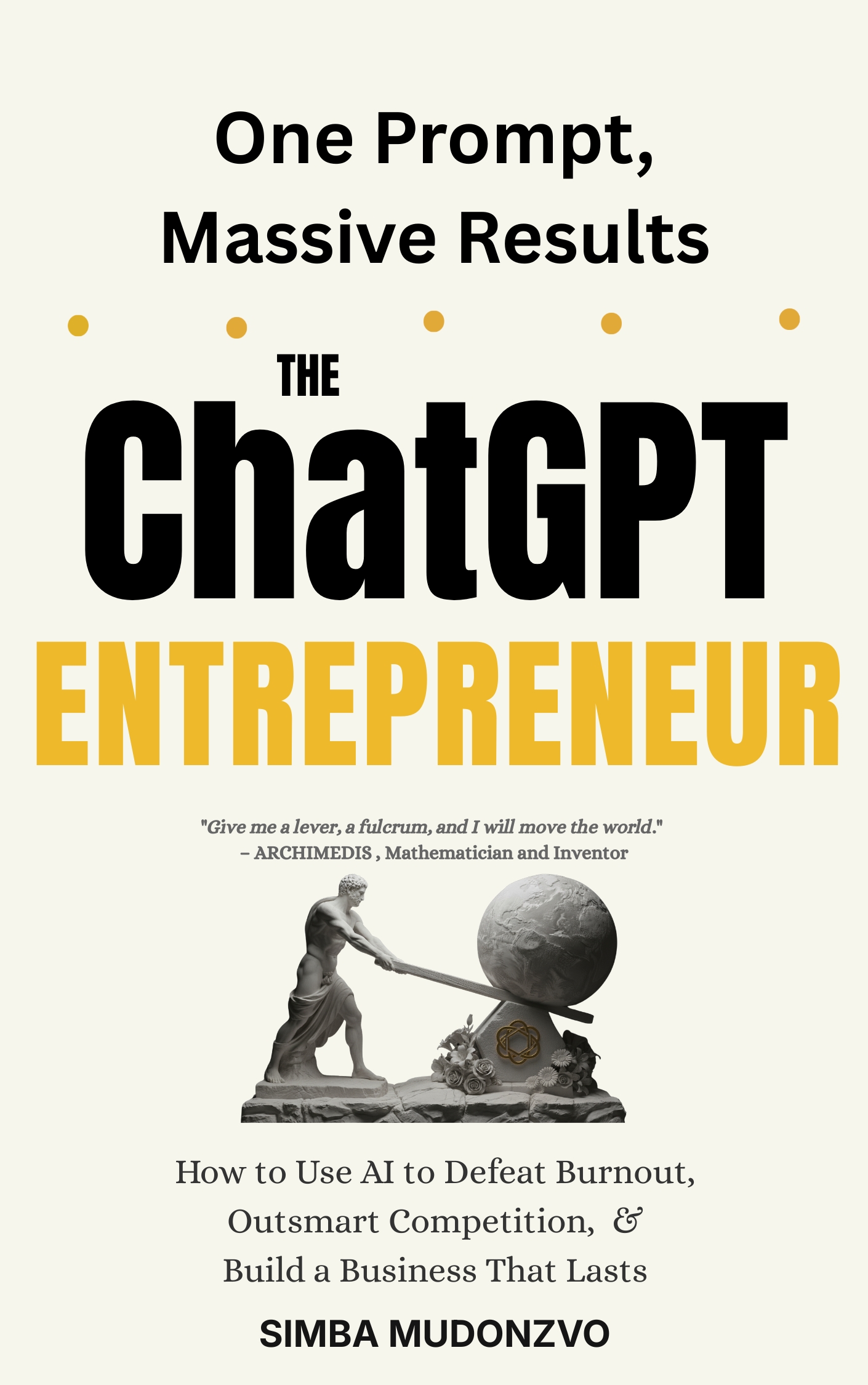
The ChatGPT Entrepreneur: How to Use AI to Defeat Burnout, Outsmart Competition and Build a Business that Lasts
Simba Mudonzvo
AN OPEN LETTER TO EVERY ENTREPRENEUR WHO IS TIRED OF WORKING HARD FOR NO RESULTS
Why your 80-hour weeks are not working—and how AI can give you a massive unfair advantage today.
Do you feel like you are shouting into a void? You stay up late. You try every marketing trick. You work until you are exhausted. But the sales do not come. This is called Effort Dissonance. It is the painful feeling when your hard work equals zero reward.
It is not your fault.
The game is rigged. Big tech companies like Google and Facebook have changed the rules. They want you to pay for every single view. You are fighting a war against giants with empty hands.
But now, you have a new weapon. The lever that moves the world has finally arrived.
AI is the new unfair advantage. It is the difference between winning and disappearing.
The ChatGPT Entrepreneur is not a boring technical manual. It is a survival guide for the Age of AI. It is for the small business owner in Mumbai, the startup founder in Lagos, and the creator in London who refuses to give up.
This book will show you how to stop guessing and start winning. You will learn how to combine your human brain (Strategy) with AI’s incredible speed (Execution).
Overview
The ChatGPT Entrepreneur posits that the foundational promise of the early internet—that merit and hard work equate to visibility—has been broken by algorithmic centralization and platform dominance, a phenomenon the author refers to as “Platform Feudalism.” Simba identifies a specific psychological condition among modern founders called “Effort Dissonance,” defined as the psychological distress caused by the widening gap between high labor input and low market return.
The text is structured into two main sections: the “Old AI Testament,” which focuses on timeless strategic frameworks adapted for the digital age, and the “New AI Testament,” which details the tactical application of AI tools to execute those strategies. The book heavily critiques the “hustle culture” and “tool-chaser” mentalities, advocating instead for “Internet Presence Optimization” (IPO) and sustainable, systems-based business models.
What is the Book About?
The book opens by diagnosing the current state of digital entrepreneurship, describing it as a “rigged game” where platforms (referred to as “Final Bosses” like Google and Meta) have shifted from value creation to value extraction (“Enshittification”). Simba argues that entrepreneurs often suffer from “The Gilded Cage,” a self-imposed prison of obsessive passion and autonomy where they become the “warden of their own exhaustion.”
The central thesis is that AI should not be viewed as an oracle or a replacement for human creativity, but as a “lever” (referencing Archimedes) that amplifies human intent. The book warns against the creation of “AI slop”—generic, low-value content generated without strategic oversight. Instead, it proposes the “Centaur Model,” popularized by Garry Kasparov, where human strategy combined with machine execution outperforms either entity working alone.
Simba reframes the entrepreneur’s role from a “doer” to a “thinker” and “portfolio manager.” The objective is to achieve “Content/Market Fit” by using AI to rapidly test strategic angles and validate demand before investing significant resources, thereby reducing financial risk and burnout.
Outline and Concepts
The book is divided into twenty chapters across two distinct parts.
Part I: Old AI Testament (Strategy)
This section establishes the strategic foundations, adapting classical business theories for the AI era.
The Effort Dissonance Epidemic: Defines the psychological toll of “1,000 views, no sales” and the disconnect between vanity metrics and business health.
The Final Boss & The Gilded Cage: Analyzes the adversarial relationship between entrepreneurs and major tech platforms, and the psychological trap of identity enmeshment in one’s business.
The Attention Wars: Discusses the “poverty of attention” (Herbert A. Simon) and argues that entrepreneurs must compete not just with rivals, but with all cognitive distractions.
Customer Ikigai: A framework for customer profiling that intersects four pillars: Problems (functional needs), Passions (identity drivers), Perceptions (internal beliefs), and Places (digital communities).
Content/Market Fit: Reverses the traditional “Product/Market Fit” model, advocating for validating messaging and audience resonance before product development.
Simba’s Five Forces: An adaptation of Michael Porter’s Five Forces for the attention economy, analyzing threats such as New Content Saturation, Format Wars, and Platform Power.
Internet Presence Optimization (IPO): A strategy for achieving omnipresence by atomizing “Star” content across multiple platforms to reduce dependency on any single algorithm.
Simba’s Content Matrix: An adaptation of the BCG Growth-Share Matrix to audit content portfolios, classifying assets into Stars (High Attention/High Conversion), Cash Cows/Evergreens (Low Attention/High Conversion), Catch-22s (High Attention/Low Conversion), and Zombies (Low Attention/Low Conversion).
Part II: The New AI Testament (Execution)
This section provides tactical workflows for using AI as a lever.
Prompting as Management: Introduces the C.O.A.R. framework (Context, Outcome, Audience, Restrictions) for effective AI interaction, treating the AI as a “tireless intern” rather than a magic wand.
The Case File (Context Injection): Demonstrates how to load “Customer Ikigai” data into AI models to generate highly specific, resonant content (“whispers”) rather than generic noise.
Finding Your Frequency: A methodology for using AI to generate multiple strategic angles and testing them organically to validate “Content/Market Fit” for zero cost.
The Intelligence Officer: Using AI for reconnaissance to analyze competitors, platform algorithms, and market trends in real-time.
Everything Everywhere All at Once: Detailed workflows for “atomizing” a single piece of pillar content into dozens of platform-native assets (tweets, reels, posts) in minutes.
The Automated Auditor: Using AI data analysis to audit content performance against the Content Matrix and ruthlessly cull “Zombie” content.
AI-First, Human Always: The guiding principle of the book—using AI for the “first draft” and execution processes, while reserving human judgment for strategy, validation, and “sculpting” the final output to ensure authenticity.
Research and Influences
The ChatGPT Entrepreneur is explicitly built upon existing academic and business literature, which the author refers to as “standing on the shoulders of giants.” Key theoretical influences include:
Clayton Christensen: The “Jobs-to-be-Done” theory forms the basis of the Problem pillar in the Customer Ikigai framework.
Michael Porter: His “Five Forces Analysis” is adapted to analyze the competitive dynamics of the Attention Economy.
Bruce Henderson (BCG): The “Growth-Share Matrix” is reimagined as the Content Matrix to manage digital assets.
Eric Ries: The Lean Startup methodology (Build-Measure-Learn) is accelerated using AI to collapse feedback loops from months to minutes.
Gary Vaynerchuk: His “Content Pyramid” model influences the Internet Presence Optimization (IPO) and atomization strategies.
Marc Andreessen: The concept of “Product/Market Fit” is adapted into Content/Market Fit.
Psychological Research: The book incorporates concepts such as Effort-Reward Imbalance (Siegrist), Cognitive Dissonance (Festinger), Obsessive vs. Harmonious Passion (Vallerand), and Cognitive Load Theory (Sweller).
Who Should Read This Book?
The ChatGPT Entrepreneur is aimed at:
Solopreneurs and Small Business Owners: Specifically those experiencing burnout, “Effort Dissonance,” or diminishing returns from traditional marketing channels.
Content Creators: Individuals struggling to maintain consistency across multiple platforms without a large team.
Digital Marketers: Professionals seeking to integrate AI into their workflows strategically rather than just for copy generation.
“Jaded Veterans”: Entrepreneurs who have become skeptical of “get-rich-quick” schemes and platform algorithms, seeking a sustainable, systems-based approach to business growth.
Read Sample
Acknowledgements
“If I have seen further, it is by standing on the shoulders of giants.”
Isaac Newton (Physicist & Mathematician)
Isaac Newton once wrote, “If I have seen further, it is by standing on the shoulders of giants.” He was being passive-aggressive toward Robert Hooke at the time, but the principle holds. This book exists because smarter people figured out the hard parts first, and I had the good sense to pay attention.
To Clayton Christensen, who gave us Jobs-to-be-Done and taught an entire generation of strategists that people don’t buy products, they hire them to solve problems. Your framework became the foundation for Customer Ikigai, and every time I help an entrepreneur or marketer understand their customer’s reason for being, I’m channeling your work. You saw what mattered when everyone else was obsessing over features.
To Michael Porter, who created the Five Forces framework and proved that competitive strategy isn’t about working harder, it’s about seeing the battlefield clearly. Simba’s Five Forces is Porter’s logic applied to the Attention Economy. You taught me that the question isn’t “Can I compete?” but “Where should I compete?”
To Bruce Henderson and the Boston Consulting Group, who gave us the BCG Growth-Share Matrix and showed the world that managing a portfolio isn’t about loving everything equally, it’s about knowing what to scale, what to milk, what to fix, and what to kill. Simba’s Content Matrix is your framework adapted for the age of content overload. You made strategy visual, and that changed everything.
To Marc Andreessen, who defined Product/Market Fit and gave entrepreneurs the language to describe that magical moment when customers start pulling your product instead of you pushing it in their faces. Content/Market Fit is that same insight applied to messaging. You taught me to stop guessing and start listening.
To Gary Vaynerchuk, who built an empire on the Content Pyramid and proved that omnipresence isn’t about having a big team, it’s about having a smart system. Your quote about the Internet being the battleground for attention inspired to start writing about how to get attention on the internet (Don’t Leave Money on the Internet, Clickonomics, The 1-Page Digital Marketing Plan and now this book) You democratized the idea that one piece of content could become fifty. The Content Pyramid model is brilliant, and Internet Presence Optimization (IPO) wouldn’t exist without it.
To Eric Ries, who gave us the Lean Startup and the Build-Measure-Learn loop. You taught an entire generation of entrepreneurs to test before they build, to learn before they scale, and to stop wasting time on things the market doesn’t want. In a way it saves them from burnout, and disappointment. The free testing method in Chapter 15 is your methodology turbocharged by AI speed.
To Garry Kasparov, who was once my chess ideal; who lost to Deep Blue in 1997 and responded by inventing Centaur Chess, proving that humans plus machines beat either alone. You gave me the mental model for the entire book: AI-First in process, Human Always in strategy. The Centaur Principle is your legacy applied to entrepreneurship.
To Cory Doctorow, who gave us “Enshittification” and the vocabulary to describe what we all felt but couldn’t name. You showed me that the platforms’ decay wasn’t a bug, it was the business model. Your clarity gave me permission to be angry and strategic at the same time.
To Shoshana Zuboff, who named and wrote about Surveillance Capitalism and explained why we’re not the customers, we’re the product. Your work validated every burnt-out entrepreneur’s suspicion that the game was rigged. You gave me the intellectual ammunition to fight back.
To Emily M. Bender, who called ChatGPT a “stochastic parrot” and reminded everyone that statistical pattern-matching isn’t understanding. Your skepticism keeps me honest. AI is a tool, not an oracle, and your work ensures I never forget that.
To Arthur Conan Doyle, who created Sherlock Holmes and John Watson and showed the world that the best partnerships aren’t competitive, they’re complementary. One thinks, the other grounds. One observes, the other documents. The Sherlock-Watson model became the organizing principle for how humans and AI should work together.
To Archimedes of Syracuse, who promised to move the world with a lever long enough and a place to stand. You gave me the central metaphor of this entire book. The internet was supposed to be our lever. The platforms broke it. AI is the new one. But the lever doesn’t move itself. The hand moves the lever. That’s you, 2,300 years later, still teaching.
To the burnt-out entrepreneurs who shared their stories with me, who admitted they were drowning, who trusted me with their midnight panic attacks and their 3 a.m. Google Analytics refreshes. You are not broken. The system is. This book is for you.
To my family, who tolerated my obsession with writing books after books for longer than was reasonable. Thank you for believing I had finished it even when I didn’t.
And to you, the reader, who picked up this book because you’re exhausted, jaded, and wondering if there’s a better way. There is. Let’s find it together.
I stand on the shoulders of giants. But the hand holding the lever? That’s yours. Let’s move the world.
Epigraph
"The computer is the most remarkable tool that we’ve ever come up with. It’s the equivalent of a bicycle for our minds."
Steve Jobs (Co-founder of Apple)
\ˈchat-jē-pē-tē\ \ˌän-trə-p(r)ə-ˈnər
ChatGPT (noun): An AI Large Language Model; a stochastic parrot that probabilistically stitches together sequences of language according to statistical patterns, without reference to meaning or understanding—mimicking intelligence through mathematical mimicry, not comprehension.
Entrepreneur (noun, from French entreprendre, “to undertake”): One who undertakes risk; in the modern sense, one who conducts business over the internet, navigating algorithmic landlords, platform feudalism, and the rigged game where the rules change overnight.
The ChatGPT Entrepreneur (noun): One who refuses the gilded cage. One who sees AI not as oracle but as a lever—a tool that amplifies human thinking without replacing it. One who brings frameworks, creativity, and lived experience to the prompt, commanding the stochastic parrot to execute while never surrendering the strategy. One who understands that the most dangerous cage is not the one you are forced into, but the one you choose, where convenience replaces thinking, where automation becomes abdication, and where you forget you ever wanted to be sovereign.
Preface: Your Sling and Five Stones
"Giants are not what we think they are. The same qualities that appear to give them strength are often the sources of great weakness.”
Malcolm Gladwell (Author of David and Goliath)
The valley is silent. Too silent. The kind of silence that makes your stomach tighten and your throat dry. It’s like standing in the valley of the shadow of death. On one side of the valley stands an army, thousands strong, armored, trained, funded by a rich king. On the other side stands another army, equally equipped, equally prepared.
But neither side is moving. Because standing between them, alone in the center of the valley, is a giant.
His name is Goliath.
He’s been standing there for forty days. Every morning, same routine. He steps forward, plants his spear in the ground, and bellows the same challenge: “Send me your best warrior. Let’s settle this, now!”
Every morning, the army of Israel hears him. Every morning, they freeze. Because Goliath isn’t just big, he’s nine feet tall, he’s gigantic, wrapped in 125 pounds of bronze armor, carrying a spear that weighs more than a thousand men. He’s the original incumbent. The established big player. The industry king who’s been dominating the market so long that everyone’s forgotten there was ever a time before him.
And then a plucky teenager shows up. Pimples sprouting on his face. With cheese. Innocent looking.
David wasn’t supposed to be on the battlefield. He was running an errand for his father, delivering food to his brothers who were actual soldiers. He was the intern with a coffee delivery. But when he heard Goliath mocking his nation, mocking his God, something inside him snapped. The same thing that snaps in every entrepreneur every single day when they see a problem nobody’s solving, an injustice nobody’s addressing, a market dominated by giants who’ve gotten too comfortable and too lazy.
“I’ll fight him,” David said.
Israel’s King Saul tried to help. He offered David his own armor. The royal armor. The best equipment money could buy. The equivalent of today’s well-meaning advice: “Spend big on Google Ads. Increase your Meta Ads budget. Write more content. Hire a fancy marketing agency. Buy the enterprise-level CRM. Sign up for the five-thousand-dollar mastermind where someone screams ‘HUSTLE’ at you while standing on a rented Lamborghini.”
David tried the armor. He strapped on the bronze helmet, the heavy breastplate, the sword. He merely took three steps before he nearly fell over. Because the armor was built for someone else. Built for a giant like Goliath. Built for someone with resources, teams, budgets, and institutional momentum.
So, David took it all off. And he went back to what he knew worked. Five smooth stones he had picked up from the stream on his way to visit his brothers. One leather sling. Simple. Timeless. Tested.
We all know exactly what happened next because every entrepreneur lives this moment. You stand in your own valley of the shadow of death with your simple tools while everyone tells you are under-equipped, under-funded, un-prepared. Goliath sees you coming and laughs. Of course, the giant always laughs. Because from his perspective, you are a joke. You do not have his massive marketing budget running into the millions of dollars. You don’t have his distribution. You don’t have his brand recognition or his economies of scale or his network effects.
But what Goliath did not know, what giants never always know, is that, as Malcolm Gladwell pointed out, their size creates blindness. Armor creates slow movement. Dominance creates complacency. And all it takes is one well-aimed stone to the one unprotected spot to bring the whole system down.
David picked up one stone. He put it in his sling. He aimed. He threw.
Goliath fell.
Isn’t it gloriously ironic that the most famous underdog victory in human history happened because the underdog refused the “best practices” and went with what actually worked. David didn’t defeat Goliath despite ignoring expert advice, he defeated Goliath because he ignored expert advice. Three thousand years later, we’re still getting the same terrible advice from so called business and marketing experts. “Compete on the giant’s terms. Use the giant’s tools. Fight the giant’s way.” And three thousand years later, entrepreneurs who refuse that advice are still the ones who win.
*****
The Breath of Life
But there’s another story you need to understand. This one happens before any battles, before any giants, at the very beginning.
Again, it’s from the Bible. In the book of Genesis, it says that God forms Adam from the dust of the ground. Shapes him perfectly. Every limb in place. Every organ functioning. Fully formed. But completely lifeless. Adam stands there like a sculpture. A mannequin. It’s like a business plan stapled together but never executed. A business idea, fully formed, but not yet in motion. A pitch deck full of fantasy than reality.
Then God does something simple but profound: He breathes into Adam’s nostrils. And Adam becomes a living soul.
That breath, that single breath is the difference between a corpse and a person. Between a concept and a reality. Between a business idea and a real business.
Your business idea isn’t alive. Your logo isn’t alive. Your mission statement isn’t alive. Your thirty-page business plan that took you three months to write and nobody will ever read isn’t alive. Your 20-slide pitch deck isn’t alive. Your app isn’t alive. A business only becomes alive when money moves. When someone buys. When a sale happens.
That first sale is like the first breath of life. Every sale after that becomes oxygen. And predictable sales? That’s the entrepreneur’s version of achieving immortality.
Imagine waking up like Tim Cook the Chief Executive Officer (CEO) of Apple—knowing with absolute certainty that tomorrow, next week, next month, millions of people will line up to buy the next iPhone from across the globe (some even want the Apple iPhone so much that they are even willing to buy a fake one!). Imagine being Sundar Pichai at Google, safe in the knowledge that every minute, thousands of businesses are paying you whether the economy is booming, crashing, or aggressively confused. Imagine having that certainty. That confidence. That peace of mind that tomorrow’s revenue isn’t a roll of the dice, or a coin toss or a prayer or desperate hope.
That certainty is the holy grail. And every entrepreneur and business craves it. Not fame. Not followers. Not the shallow dopamine hit of vanity metrics. Just the simple, profound confidence that tomorrow you’ll wake up to notifications of sales, emails with new leads, messages from your sales team about closed deals and a dashboard full of green arrows pointing upwards.
The internet once gave us this certainty. In the early days, the golden age that old-timers talk about like war veterans reminiscing about battles, you could build a simple website, write decent content, and actually get found within days. Organic reach was real. Google search ads were cheap. Banner ads were cheap too. Platforms hadn’t yet figured out how to extract every dollar from your pocket while giving you less and less in return.
Now?
The internet is noisy. Platforms are rigged. The game is rigged. You want web traffic? Better bring out your wallet and pay-to-play – this is not the P2P we were promised. Every algorithm is a moody teenager with the attention span of a goldfish and the vindictiveness of a reality TV villain. Burnout isn’t just common; it’s basically a rite of passage now. The badge of honor that proves you’re “serious” about your business because apparently suffering equals commitment. So they say.
You do not need to be an oracle to see what happened at the systems level. The internet underwent what economists call “rent extraction.” Platforms that started as open ecosystems, they were the tools that empowered entrepreneurs and businesses but slowly closed their gates and started charging for access. Facebook went from free organic reach to algorithmic suppression unless you pay. Google went from “create good content” to “create good content, then pay us to show it to people searching for exactly what you created.” The platforms didn’t get worse at their job. They got better at monetization. And you, the entrepreneur trying to breathe life into your business became the product being monetized. That’s Enshittification in a nutshell.
But here’s what most people miss. Here’s what the gurus selling you the next shiny tactic don’t want you to realize. Here’s what makes this moment, right now, in 2025 and beyond, the most important inflection point for entrepreneurs since the internet became mainstream:
Generative AI just reset the entire game.
*****
Your Sling and Stones
You are standing in your valley right now. Your Goliath might be Amazon. Or a venture-backed startup fresh out of Y Combinator that just raised $50 million. Or an established brand with a century of market dominance. Or the platform algorithms that suppress your reach unless you pay them. Or the burnout that’s turned you from an excited entrepreneur into an exhausted shell going through the motions.
You are being handed heavy armor again. The king’s advisors, the modern marketing gurus and growth hackers on social media are telling you to spend big, scale fast, hire teams, automate everything, post constantly, engage relentlessly, optimize endlessly.
And you are trying it on. You’re strapping on the Google Ads armor, the Meta advertising breastplate, the influencer marketing helmet, the content calendar sword. And you can barely move. Because it’s built for giants. For companies with venture funding and growth teams and marketing agencies on a monthly retainer.
Here’s what I’m handing you instead: your sling and your five stones.
The sling is AI. Not as magic. Not as salvation for your bad business idea. Not as the solution to all your problems. But as LEVERAGE. As the tool that finally lets David move at Goliath’s speed without Goliath’s resources.
And the five stones? The five stones are frameworks. A way of thinking. A way of doing business on the internet. The five stones are new but familiar. They are based on timeless principles that worked before the internet, during the early internet, through every platform change and algorithm update and economic crisis, and will continue to work well into the future. These aren’t tactics that expire when the next social media platform launches, or when AI morphs into agentic AI or when Quantum Computing finally arrives. These are strategic foundations that stand the test of time.
Stone One: Customer Ikigai. Know who you serve better than they know themselves. Understand the four pillars that drive their behavior especially online—their Problems, their Passions, their Perceptions, and where they hangout (Places). This framework has worked since the first human traded a tool for food and it will work when we’re selling services on Mars.
Stone Two: Content/Market Fit. Stop creating content and hoping it works. Test your message for resonance before you spend money scaling it. Find the whisper that makes your customer say “This business understands me” before you amplify it into the black void.
Stone Three: Simba’s Content Matrix. Know what’s working. Not what you feel is working or hope will work, but what the data proves is working. Stars, Zombies, Catch-22s, and Evergreens. Classify every piece of content you create and know exactly what to scale, fix, protect, or kill.
Stone Four: Simba’s Five Forces. Understand the battlefield. Gary Vaynerchuk describes the internet as a battleground for attention. To get attention you have to fight for it, and content is your weapon. Simba’s Five Forces is (1) the threat of new content drowning out your own. (2) The threat of different content formats making your 10,000-word SEO-optimized blog post obsolete before you even hit publish on your WordPress site (3) The competition, direct and indirect fighting for the same attention. (4) The platforms extracting rent from your reach and content creators who have more influence on your potential customers than you do. (5) Then the customers, the users, the strangers on the internet who hold the ultimate trump card, all the aces, all the power to ignore you completely or give your business wings and cross the chasm.
Stone Five: Internet Presence Optimization (IPO). Be omnipresent without burning out. Show up everywhere your customer gathers, not through brute force and 80-hour work weeks, but through intelligent atomization and strategic distribution.
These are your five stones. These are your strategic foundations. And AI? AI is what lets you throw them with precision at the speed of light towards Goliath, and your competition.
*****
Why Now? Why This Book? Why Another Book for Entrepreneurs?
Because the battlefield has changed but the enemy hasn’t. Giants are still giants. Algorithms are still algorithms. Platforms still favor the big businesses. The game is still rigged.
But entrepreneurs still have something the giants don’t: speed, creativity, courage, human insight, and now, for the first time in human history, access to the same computational power that used to require entire teams and big money to access.
Ten years ago, if you wanted to be omnipresent across five platforms, you needed Gary Vaynerchuk’s twenty-person content team. Today, you need just ChatGPT, your thinking brain and some minutes. Ten years ago, if you wanted competitive intelligence on your market, you needed expensive consultants and months of research. Today, you need the right AI prompts, your thinking brain (again) and some seconds. Ten years ago, if you wanted to test ten different marketing messages, you needed ten different campaigns and ten thousand dollars. Today, you can test for free in the communities where your customers gather and let the market tell you which message wins.
This isn’t about replacing your thinking with AI. This is about amplifying your thinking with AI. This is about being AI-First in process, always asking “Can AI do this?” before you do it manually and burn out—and Human Always in strategy—always validating AI’s output against your Customer Ikigai, always injecting your voice, always applying your judgment.
This is the Centaur model. Human strategy plus AI execution. Sherlock Holmes commanding Watson. The thinking entrepreneur who uses AI as the lever that moves worlds.
The gurus are selling you two false choices. Either you’re a human purist who manually creates everything and burns out within a year, or you’re an AI-slop generator who copy-pastes generic garbage prompts into AI and wonders why nobody engages with your freshly minted AI-slop. Both paths lead to failure.
This book gives you the third path. The path where you get Goliath’s speed and David’s soul. Where you work faster without losing your humanity. Where you’re omnipresent without burning out. Where you finally connect your effort to your results instead of shouting into the algorithmic void.
*****
What This Book Promises You
By the time you finish this book, you’ll have your complete system. Part 1 is your Old Testament—the five thinking frameworks that give you strategy. Part 1 is preparation for the arrival of AI. Part 2 is your New Testament. The New AI Testament. AI has arrived. Now you use AI as an execution tool that gives you speed.
You will know how to use Customer Ikigai to find whispers that resonate instead of guessing what might work.
You will know how to test for Content/Market Fit for zero dollars instead of burning your budget on campaigns that flop.
You will know how to use AI to audit your entire content portfolio in thirty seconds and know exactly which pieces are Stars worth scaling, Zombies worth killing, Catch-22s worth fixing, and Evergreens worth protecting.
You will know how to deploy your AI Intelligence Officer (soon AI Agent) to scout the Internet across all five forces and find the Hot Gates—the narrow chokepoints where you can actually win attention and get sales.
You will know how to atomize one Star piece of content into fifty platform-native pieces in ninety seconds, making omnipresence sustainable instead of suicidal.
You will know how to implement the AI-First in process, Human Always in strategy so that you’re fast like Goliath but human like David.
And most importantly, you’ll know how to breathe life into your business every single day. How to create the certainty that tomorrow you’ll wake up to sales, leads, and momentum instead of silence, anxiety, and dread.
This isn’t another book about AI prompts. This isn’t another course about ChatGPT or AI hacks. This isn’t another guru telling you to hustle harder while they profit from your desperation.
This is the playbook for defeating burnout, outsmarting competition, and building a business that lasts. This is your strategy upgraded for the AI age. This is your fighting chance.
*****
One More Thing
The valley is waiting. Goliath is standing there, mocking you, telling you you’re too small, too slow, too under-resourced to win. The king’s advisors are offering you armor you can’t move in and tactics that benefit them more than you.
But you have something they don’t. You have your sling. You have your five stones. And you have the courage to use them.
David didn’t defeat Goliath because he had better weapons. He defeated Goliath because he aimed.
You now have better stones than David ever did. You have frameworks built upon business frameworks developed by the greatest strategic minds in business history. You have AI that can execute those frameworks at the speed of thought. You have this complete playbook for being fast and good, strategic and tactical, human and leveraged.
But the sling doesn’t throw itself. The stones don’t aim themselves. The frameworks don’t execute themselves.
You are the hand. Your thinking is the force. Your willingness to act is what separates this moment from every other moment you’ve spent reading business books, taking courses, and hoping something would change.
Welcome to The ChatGPT Entrepreneur. Welcome to your fighting chance. Welcome to the beginning of the end of your burnout and the start of the business you actually wanted to build.
Let’s go slay your giant.
Part I: Old AI Testament
“I very frequently get the question: 'What's going to change in the next 10 years?' I almost never get the question: 'What's not going to change in the next 10 years?' And I submit to you that that second question is actually the more important of the two.”
Jeff Bezos (Founder of Amazon)
Author’s Note
Let me be honest with you from the start. This book is structured differently than most business books you’ve picked up.
Part 1 which is the part you’re about to read doesn’t immediately hand you AI prompts or growth hacks or the “7 secrets to 10X your revenue.” It won’t give you the dopamine hit of a tactical checklist you can implement in the next five minutes. And if that’s what you’re looking for, I need to warn you: the first few chapters might feel like you accidentally picked up an issue of Psychology Today instead of a business book.
There’s a reason for that. And I need you to trust me on this one.
The Old Testament
I call Part 1 “The Old Testament.” Not because I’m comparing this book to anything sacred, but because of the structure. The Bible’s Old Testament came before Christ and it laid the foundation, established the principles, told the stories that would make the New Testament meaningful. Without understanding the Old Testament, the New Testament loses its power.
Part 1 of this book works the same way. This is pre-AI. This is before you get your hands on ChatGPT or Claude or whatever tool you’re excited about. This is where you pick up ideas, challenge assumptions you didn’t know you had, learn about frameworks that have stood the test of time, and understand why AI is a lever in the first place.
Part 2 is the “New Testament,” it is where you get to use AI to execute everything from Part 1. That’s where the prompts live. That’s where the tactical implementation happens. That’s where you learn how to use the lever.
But you can’t skip the foundation. You can’t jump straight to Part 2 and expect it to work. Because without understanding why these frameworks matter, without internalizing the strategic thinking, you’ll just be another entrepreneur with a $20 ChatGPT subscription and no idea why your content still isn’t working.
Read, Bookmark, Think, Come Back
Here’s how I want you to read Part 1: Slowly. Deliberately. With a pen in hand or your notes app open.
Read a chapter. Bookmark it. Close the book. Go away. Think about it. Let it simmer. Ask yourself uncomfortable questions. Then come back.
As I wrote this book and as I re-read it several times during editing I oftentimes found myself asking deep questions I have been avoiding for years. I realized I was suffering from burnout without even knowing it. I was getting depressed without understanding why. Effort Dissonance, I realized it later. Maximum input, minimum output, no clear connection between the two.
I had to question the passions driving my work. Were they harmonious or obsessive? Could I walk away and relax, enjoy my time away from the business, or was I stuck, and have become a slave to an invisible harsh boss I had created for myself in my own worst image?
Those aren’t comfortable questions. But they’re necessary. Because you can have all the AI tools in the world and still burn out if you’re running on a foundation of dysfunction.
What This Part Promises You
My job in Part 1 is to inform you, educate you a little, entertain you (or spoil great films for you—sorry in advance!), and most importantly, transform you. Transform the way you think, the way you do business, and what you want to get out of this entrepreneurial journey.
I’m not here to make you hustle harder. I’m here to help you think clearer.
A Confession about Frameworks
Let me tell you how the five frameworks in this book came to exist. Because I need you to understand they weren’t born from genius or a desire for fame. (Trust me, you don’t get famous creating business frameworks!) You get obscure academic citations and maybe a LinkedIn post that gets 7 likes.
Several years ago, I wrote a book about SEO. Before writing it, I had exhausted every blog post about SEO I could google on the internet. Neil Patel (who kept popping up on the first page of every search). Ahrefs. Moz. Mangools. SEMrush. Backlinko. HubSpot. Matt Diggity. Matthew Woodward. Charlie Floate (who oddly called himself the God of SEO). Glen Allsopp (Who had to leave England and go to South Africa and learn SEO and come back and dominate SEO). Nathan Gotch. The guy from Web Iris. And many more others.
I consumed everything. Then I wrote what I thought was the best book on SEO ever written. A thousand pages long. Published it on Amazon. Got a sale immediately.
Instead of celebrating, I panicked. I unpublished the book immediately and took it down.
Why?
Because I felt a sudden rush of imposter syndrome so powerful I could barely breathe. All I had done was read and watch a bunch of content about SEO and synthesize it into writing. The bestselling book on SEO had pretty much done the same thing. I had just done it at 10X levels.
But I hadn’t offered anything different. I had just behaved like ChatGPT before ChatGPT existed or like Google’s AI Overview, just synthesizing stuff and sharing it in a book. I felt like a fraud.
I went back to the drawing board. I decided I was going to create actual value, not just repackage existing information that’s already on the internet.
I studied and researched the most popular business frameworks. Read all the history of strategy. Read all the frameworks—Porter’s Five Forces, the BCG Growth-Share Matrix, Jobs to be Done, Product/Market Fit, Gary Vaynerchuk’s Content Pyramid. I settled on the ones I thought I could adopt, evolve, and make useful for entrepreneurs, marketers, and businesses that want to do business on the internet.
I used first principles thinking—before Elon Musk made it cool—and spent time cracking and pricking my brain. I came up with principles. I briefly wrote about them on r/marketing (a subreddit on Reddit), and they were well received.
Then life and COVID got in the way.
Eventually, I wrote books containing these theories and frameworks. But I’ll be the first to admit: they came across as brash. “Hey, look how smart I am to invent new frameworks, now worship at my altar.” A bit preachy. “Hey, I know more than you do.”
I got some sales and positive reviews. But I knew I had to change the angle, not the message.
The Little Book That Taught Me Everything
While I was publishing books and hoping they had hit the big time, I kept noticing something. A little book called “The 1-Page Marketing Plan” kept making consistent sales every month. It wasn’t flashy. It wasn’t promising overnight riches. It was just solid, practical, and helpful.
It became my cash cow. An evergreen tree that generated income month after month. And I realized: that’s what actually works. Not the brash, look-at-my-genius approach. The humble, here’s-what-actually-helps approach.
I had eaten a full dozen humble pies by that point. I resolved that once I finished publishing “The Gilded Cage”—a book about how AGI is the greatest deception in human history—I would do something about it.
I decided to write this book instead. To incorporate elements from that little cash cow book and show you how to use AI as the lever.
What to Expect in Part 1
Part 1 is going to challenge you. It’s going to make you think about why you’re burnt out. Why your effort doesn’t connect to your results. Why you feel like you’re shouting into a void. Why the game feels rigged.
We’re going to talk about passion versus obsession. About harmonious engagement versus compulsive drive. About the psychological toll of entrepreneurship in the age of algorithmic tyranny.
We’re going to examine five frameworks—Customer Ikigai, Content/Market Fit, Simba’s Content Matrix, Simba’s Five Forces, and Internet Presence Optimization—that will become your strategic foundation. Your rocks before you pick up the sling.
We’re going to reference films, history, psychology, and business strategy. We’re going to take detours that seem tangential but aren’t. We’re going to build a foundation so solid that when you get to Part 2 and start using AI, you’ll know exactly why each prompt works and how to adapt it to your specific situation.
Why You Can’t Skip This
I know you’re tempted. I know you want to jump to Part 2 where the AI prompts live. Where the tactics are. Where the “how-to” lives.
Don’t.
Because without Part 1, Part 2 is just another collection of prompts that might work for someone else but won’t work for you. Without understanding Customer Ikigai, your AI-generated content will be generic. Without understanding Content/Market Fit, you’ll scale the wrong message. Without understanding the Content Matrix, you’ll waste effort on Zombies instead of scaling Stars.
The frameworks are the rocks. AI is the sling. You need both to defeat Goliath. But you need to understand the rocks first.
My Promise to You
I promise to be honest with you. I won’t pretend I have all the answers. I won’t sell you magic pills. I won’t tell you to hustle harder when what you need is to think clearer.
I’ll share my failures as openly as my successes. I’ll tell you when I panicked and unpublished a book. I’ll tell you when my previous books came across as brash and preachy. I’ll tell you about my own burnout and depression and effort dissonance.
Because you need a battle-scarred mentor, not a guru on a pedestal. You need someone who’s been in the trenches, not someone who’s only ever theorized from the comfort of an ivory tower.
One More Thing
Part 1 is called “The Old Testament” for a reason. It’s the foundation. The covenant. The principles that existed before AI and will exist after whatever comes next.
AI changes quickly. ChatGPT today, something else tomorrow. The tools evolve. The tactics expire. The platforms shift.
But strategy? Strategy is timeless. Understanding your customer? Timeless. Testing for resonance before scaling? Timeless. Knowing what’s working versus what’s failing? Timeless. Being omnipresent without burning out? Timeless.
That’s what Part 1 gives you. The timeless rocks that you’ll carry into every battle, regardless of what sling you’re holding.
So read slowly. Think deeply. Bookmark the chapters that challenge you. Close the book when you need to process. Come back when you’re ready.
Part 2 will be waiting for you. The AI prompts aren’t going anywhere. The tactical execution will be there when you’re ready.
But first, you need to understand why the rocks matter.
Welcome to Part 1. Welcome to the Old Testament. Welcome to the foundation that will make everything else possible.
Now let’s begin.
—Simba
Introduction
“Give me a lever long enough and a fulcrum on which to place it, and I shall move the world.”
— Archimedes (Mathematician & Inventor)
It is a truth universally acknowledged that an entrepreneur in possession of a good idea must be in want of a lever.
Archimedes promised he could move the world if you gave him one. The internet promised to be that lever. Then the platforms broke it, sold you the pieces, and called it innovation.
*****
Syracuse, Sicily. 250 BCE. A beach. The Mediterranean sun beats down. Archimedes of Syracuse stands watching a ship too heavy for a hundred men to move. His hands are covered in sand. His mind is obsessed with a problem. Not just any problem. His magnificent obsession: How to amplify human strength beyond the limitations of muscle and bone.
The story goes that he inserted a long wooden beam under the hull. He positioned a rock as a fulcrum. Then he pushed down on the far end. The ship groaned. The wood creaked. And then, as if by miracle, it lifted.
Archimedes turned to King Hiero. His voice was calm. Matter-of-fact. The voice of a man who just proved the impossible. “Give me a place to stand, and a lever long enough, and I will move the world”.
That promise echoed for millennia.
For two decades, every entrepreneur believed the internet was their lever. The lever they could use to change the world. Or at the very least, make a small dent.
You remember when the internet actually worked. 1999. A young investment banker named Jeff Bezos read a report about internet web traffic exploding at 2,300% annually. Not 23%. Not 230%. Two thousand, three hundred percent. He immediately quit his lucrative and prestigious job at D.E. Shaw to sell books on the internet from his garage.
No permission from publishers. No lease negotiations with office landlords. Just a website that cost a few hundred dollars and a belief that the future belonged to anyone willing to build a business on the internet. You believed that same story. You were told the playing field had been leveled. You could launch a business on a hungover Sunday, post something good, and by miracle of miracles, random strangers would see it and buy whatever you were selling.
This was the story for Jeff Bezos and Amazon. This was the story for thousands of entrepreneurs who saw the internet as a lever. The barrier to entry wasn’t capital anymore. It was creativity. The risk wasn’t whether you could afford to build. It was whether you could find an audience. That felt like a fair fight.
Then one day, the platforms did something Archimedes never predicted. They started charging you rent to use the lever. They demanded a subscription. Worse still, they tilted the fulcrum. Then, they set the lever on fire and sold you a charred stick while calling it an “upgraded experience”.
Google, the self-appointed librarian of human knowledge, now steals your carefully researched blog post and serves it as a “zero-click answer” at the top of search results. You did the work. They took the traffic. You’re still pushing the lever, but you’re not moving the world anymore. You can’t. You’re just filling their quarterly earnings report while fantasizing about setting your laptop on fire.
Meta, formerly Facebook and still referred to by many as Facebook, rebranded after becoming so toxic it needed a witness protection program. Facebook hands you a lever made of “100 percent genuine engagement” that turns out to be bot traffic from India and Manila click farms. You spent five years building a Facebook page with 100,000 fans. Your organic reach is now 0.3% unless you pay the ransom they call “boosted posts”. You’re not running a business. You’re literally negotiating with digital kidnappers.
The lever is broken. And the exhaustion you feel isn’t a personal failure. It’s physics. You’re trying to move a world that’s been firmly welded deep into the ground.
The Social Contract You Didn’t Know You Signed
Let’s go back to the beginning. Because understanding what you’ve lost is the only way to understand what you’re about to reclaim.
The early internet, roughly 1995 to 2010, operated on an unspoken social contract. The deal was simple: if you built something good and worked hard, the platforms would give you visibility. The platforms were tools, not gatekeepers. They made money when you made money. Fair deal.
This era was a genuine technological paradigm shift, not marketing hype. Clay Shirky, the media theorist, called it “mass amateurization,” the collapse of traditional gatekeepers between creators and audiences. David Bowie, in a now classic BBC interview, warned that the middleman was about to be eliminated by the internet.
Before the internet, if you wanted to publish a book, you needed a publisher’s permission. If you wanted to sell a product nationally, you needed capital to rent shelf space at Walmart. The internet dissolved the publisher’s role entirely. You didn’t need permission anymore. You could just publish.
This wasn’t theoretical. Kauffman Foundation data shows the 2000s saw explosive new business formation, a Cambrian explosion of solopreneurs, bloggers, and micro-multinationals serving global audiences from kitchen tables and garages. The internet created what economists called the “Long Tail,” a marketplace where you could build a sustainable business serving a niche audience of 1,000 true fans scattered across continents, people Walmart would never stock a shelf for.
The economics were permissionless. The barriers were obliterated. The primary risk shifted from “Can I afford to start a business?” to “Can I find my audience on the internet?” That was a risk an individual could take. That was a fair risk.
The platforms of that era, early eBay, early Google, early Facebook, were market-makers, not market-owners. They created the infrastructure; search, payments, social graphs, and charged a small transaction fee. When you won, they won. When you grew, they grew. It was symbiotic. Positive-sum.
That’s the world you thought you were building in. That’s the promise that got sold to you in every Gary Vee video and Tim Ferriss podcast. “The internet has democratized entrepreneurship!” they shouted. And for about fifteen years, it was actually true.
Then the fulcrum moved. In fact, it was stolen.
Around 2010, something shifted. As Ernest Hemingway would remark, it happened gradually, and then suddenly. The open web, built on permissionless protocols like HTTP, was quietly, systematically replaced by walled gardens. The market wasn’t on the web anymore. The market was INSIDE Facebook’s algorithm, Amazon’s marketplace, Google’s search results, and Apple’s App Store. If you wanted to reach customers, you had to go where they were. And where they were was locked inside proprietary platforms that could change the rules whenever they wanted.
The technical term for what happened is “network effects,” a dynamic where a platform becomes more valuable as more people use it. Buyers go to Amazon because all the sellers are there. Sellers go to Amazon because all the buyers are there. This creates a gravity well that collapses into a winner-take-all monopoly.
The democratization of the first era contained the seeds of its own destruction. The platforms used the open web’s symbiotic phase to achieve critical mass. Once they had you locked in, they pivoted.
They stopped being your partner. They became your landlord. And then, inevitably, predictably, they became your competitor.
Think of it like this. You’re a farmer. The landowner says “Plant whatever you want, we’ll split the harvest 50/50.” You spend five years building the soil, the irrigation, the crops, buying the equipment, and hiring staff. Then, the landowner says “Actually, we’re taking 90% now. Also, we’re planting the same crops next to yours and selling them for half your price. Also, if you complain, we’ll evict you.” That’s not farming. That’s feudalism. Welcome to Platform Feudalism.
Welcome to Platform Feudalism
Shoshana Zuboff, the Harvard economist, gave this new system a name: Surveillance Capitalism. It’s not regular capitalism, where companies make products and sell them to customers. It’s a new economic logic entirely.
Here’s how it works.
You think you’re Amazon’s customer because you pay them fees to access their marketplace. You’re not their customer. You’re their data source. Every sale you make, every price you test, every customer review you earn, that’s what Zuboff calls “behavioral surplus”. Amazon harvests that data, that “behavioral surplus”, analyzes it with machine learning, identifies your best-selling products, and then launches their own cheaper version under the Amazon Basics label. They use your data to compete with you, undercut you, and drive you out of business. Platform feudalism in a nutshell.
You’re not building a business on their platform. You’re building a dataset they can monetize. This would be brilliant if it wasn’t so sociopathic. It’s like if your landlord installed cameras in your apartment, watched you develop a sourdough bread recipe, then opened a bakery next door using your exact formula and charged half your price. Except it’s legal, because you clicked “I Agree” on a 100-page Terms of Service you definitely didn’t read at 2 a.m. when you were setting up your Amazon seller account.
This is the core of the rigged game. An entrepreneur operating on Amazon or Google exists under a fundamental illusion: they believe they’re paying for a service. In the logic of surveillance capitalism, they’re providing a service, free R&D, market testing, customer acquisition, that the platform harvests and weaponizes against them.
Here’s the hard truth: you cannot out-work a surveillance data advantage. You cannot out-innovate an opponent who sees your cards face-up while you play blind. This isn’t a personal failing. It’s an information asymmetry built into the architecture of the system.
Enshittification
If Surveillance Capitalism is the economic engine of your burnout, “enshittification” is the process model that explains the bait-and-switch you’ve lived through.
Cory Doctorow, the science fiction author and tech activist, coined the term to describe a predictable three-stage decay cycle that platforms follow.
Stage 1 – Good to Users: The platform launches with a genuinely great service, often at a loss, to lock in a critical mass of users. Google’s search results were clean and relevant. Facebook let you actually see posts from your friends. The platforms were good in this phase because they needed people to join them and invite their friends and family to join them too. You’re seeing this now with AI LLM chatbots like ChatGPT, Claude, Gemini, and so forth.
Stage 2 – Good to Business Customers: Once users are locked in by network effects i.e. everyone’s on Facebook, so you have to be on Facebook; the platform pivots to attracting producers that is businesses and entrepreneurs like you and me. They offer an incredible deal: “Reach millions of people for free!” “List your products in front of millions!” This is the phase that felt like the lever. This is the phase that hooked you in.
There’s a YouTube video of Gary Vaynerchuk saying how he used to pay cents, yes $0.01 to Google to get customers for his family’s Wine Library business. Platforms always start good to everyone, including Business Customers. It was the same with Facebook Ads. You could acquire customers for less than a dollar.
Stage 3 – Good to Shareholders: Once both users and producers are locked in with high switching costs; you can’t leave Amazon because that’s where the customers are and customers can’t leave Amazon because that’s where all the inventory is then the platform starts abuse both groups to extract all the value for shareholders. Google inserts ads disguised as search results. Amazon forces you to pay for sponsored placements just to appear on page one of your own product category. Facebook chokes your organic reach to zero and ransoms it back to you for $50 per boosted post.
This is the enshittification stage. This is the broken lever.
And here’s the part that should make you furious: this was always the plan from the very beginning. The platforms weren’t good to you in Stage 2 because they valued you. They were good to you because they needed to extract value from you in Stage 3. You were never the customer. You were always the bean crop.
The enshittification you’re experiencing isn’t a bug. It’s not a temporary rough patch. It’s not something you can “hack” your way out of with better SEO or a new ad strategy or new growth marketing hack. It is the intended destination of the platform’s business model. Doctorow calls it “twiddling,” the continuous adjustment of algorithmic parameters in search of marginal profit increases, without regard to any goal other than shareholder value.
You refresh your analytics like a gambler at a slot machine because the house keeps moving the payout algorithm. Except the house always wins. And in this casino, the house is also allowed to rifle through your wallet while you sleep.
The Algorithmic Landlord
Let’s talk about what this does to your brain. Because the statistics are not pretty and you need to know you’re not alone.
Entrepreneurs in the platform era don’t serve one master anymore. You serve two: your customer, and the algorithm. Your customer wants quality, value, and authentic connection. The algorithm wants engagement metrics, ad spend, and compliance with opaque rules that change every day. These two masters have opposing demands. Serving one means betraying the other. This is what researchers call “effort-reward imbalance,” and it is clinically a predictor of the burnout you are feeling right now.
Here are the numbers, and they’re brutal:
80% of entrepreneurs report struggling with at least one mental health issue. 50% report anxiety.
34% report burnout specifically, not “I’m tired” burnout, but clinical, diagnosable, “I want to shut this whole business down and never touch a laptop again” burnout.
62% of entrepreneurs feel depressed at least once a week. Not once a year. Once a week!
Entrepreneurs are twice as likely to suffer from depression compared to everyone else, and ten times more likely to be diagnosed with a bipolar disorder.
The stats keep coming.
22% of entrepreneurs report insomnia.
30% report chronic sleep disturbances.
And here’s a kick while you’re down: 81% of entrepreneurs aren’t open about these struggles. There’s a culture of silent suffering, because admitting you’re drowning feels like admitting you’re not “entrepreneur material,” you’re not built for this, not built to last.
You need to hear this: It’s not you. It’s the system.
The burnout of the early internet era, let’s call it 1999 to 2009, was a market challenge. “Can I find product-market fit? Can I reach my audience?” That was solvable stress. It could be met with creativity, iteration, and hard work. You had agency.
The burnout of the platform era, 2010 to now, is a sovereignty challenge. “Will the algorithm let me reach my followers? Will Amazon suspend my account for a policy violation I can’t appeal? Will Google Search steal my content and give me zero traffic?” This is unsolvable stress. It’s the stress of powerlessness. You’re a serf, a tenant on rented land, subject to the whims of an algorithmic landlord who can evict you overnight with no explanation and no recourse.
This is what psychologists call “loss of agency,” and it is the fastest route to clinical burnout. You’re working harder than ever, 73% of small business owners take fewer than 20 vacation days per year, and seeing worse results. You hit 1,000 views on your post and got zero sales. You spent $5,000 on Facebook ads and got 143 clicks from bots in Bangladesh. You’re not failing because you’re not smart enough or not working hard enough. You’re failing because the lever is, dare I say it, permanently broken.
Entrepreneurs used to take risks to reduce uncertainty. You would test, iterate, optimize, and build toward certainty, certainty you’d make payroll, certainty you’d hit revenue targets, certainty you’d survive for a while. That certainty gave you peace of mind. Algorithms destroyed that. Now you wake up every morning not knowing if Google rolled out a “Helpful Content Update” that tanked your traffic by 80 percent overnight. You’re playing a game where the rules change mid-match and the referee is actively betting against you.
Here’s the exquisite irony: we went from fearing our parents’ generation’s corporate overlords to building our livelihoods on platforms run by hoodie-wearing billionaires who somehow convinced us that this was freedom. At least your grandfather’s boss had to look him in the eye when firing him. Your boss is an algorithm named BERT or Panda. Cute names for brutal executioners.
The Charlatan Economy
This desperation, this agonizing dissonance between massive effort and non-existent results, has created a gold rush. Not for entrepreneurs. Not for businesses. For charlatans.
YouTube and TikTok are now flooded with gurus promising to teach you “the secrets the algorithm doesn’t want you to know”. Dropshipping. Passive income. Amazon FBA. “I made $10K in 30 days and you can too!”
They’re selling you the dream of beating the rigged game.
Here’s the problem: they’re not lying about their success. They did make that $10,000 in 30 days. By selling you a $997 course on how to make $10K in 30 days. Their business model isn’t Dropshipping. It’s you. You’re the product. Again.
I’ve been there. I’ve bought the courses. I’ve followed the “proven frameworks”. And I’ve watched them stop working the moment the algorithm “twiddles” again. The gurus aren’t ahead of the curve. They’re selling you the curve that already passed.
This is not to say all education is a scam. It’s to say that any education promising to teach you how to “hack” or “beat” the algorithm is teaching you to out-gamble a casino. The house edge is built in. You might win once. You won’t win consistently. And every hour you spend learning to game the algorithm is an hour you’re not spending building something the algorithm can’t take away.
The AI Inflection Point
So where does that leave you? Burnt out, jaded, algorithmically homeless, and wondering if entrepreneurship was a massive lie sold to you by people who got in early and pulled the ladder up behind them.
Here’s the world-changing idea this book is built on:
The unspoken social contract of the internet, that a good idea and hard work could level the playing field, has been broken. The burnout you feel is not a personal failure. It is a rational response to a rigged system. The platforms tilted the lever, and you’re exhausted from pushing a tool that no longer works.
But here’s the thing about paradigm shifts: they don’t announce themselves politely. They show up as chaos. And in the chaos, there’s a brief window where the power structure hasn’t solidified yet.
AI is that window.
On November 2022, OpenAI launched ChatGPT. It gained one million users in five days. Not five months, not five weeks, definitely not five years, but five days. You could feel it in the air: the collective sigh of every burnt-out entrepreneur on the planet going, “Finally. Something that might make this less painful”.
But here’s what most people missed: ChatGPT didn’t gain a million users because the technology was revolutionary. The technology had existed in research labs for years. Google had it. It was their engineers who wrote a now famous paper called “Attention is all you need” that gave birth to transformers, the T in GPT. It gained a million users because it hit the market’s emotional nerve. Everyone wanted a new lever. Everyone was desperate for a tool that could restore agency, that could bypass the algorithmic landlords, that could give them back the permissionless innovation the internet once promised.
Two years later, the data is in. And it tells two very different stories.
Story One: AI is a proven lever. Real-world case studies show consistent results across industries. E-commerce businesses seeing 15% increases in cart size and 12% retention improvements, with return on investment in 45 days. Digital agencies saving 8 to 10 hours per week, increasing billable capacity by 20%. Manufacturing SMEs preventing $5,000 in downtime and reducing maintenance costs by 25%. Content agencies doubling output from 80 to 160 articles per month, saving 85 hours.
McKinsey’s lighthouse factories, the companies at the cutting edge of AI implementation, achieved 2x to 3x productivity increases and 50% improvements in service levels. These aren’t projections. These are measured outcomes from using AI.
Story Two: 74% of companies can’t capture the value. Boston Consulting Group’s 2024 research makes an interesting read: three-quarters of companies have invested in AI, hired talent, launched pilots, and failed to move beyond proof-of-concept. They have the tool. They don’t have the thinking.
Only 26% have developed the capabilities to generate tangible value. Just 4% have cutting-edge AI capabilities across functions with consistent, significant value generation. The gap isn’t the technology. The gap is strategic frameworks, the mental models that translate AI from expensive experiment to operational and strategic leverage.
This is where the gurus failed you before, and where this book will not. I am willing to die on that hill.
This Book is not a Magic Pill
Let me be very clear about what this book is and is not.
This is not a book about “AI hacks” or “ChatGPT prompts that will change your life”. Those books exist. They’ll be obsolete by the time GPT-6 or so-called AGI arrives.
This is not a book telling you to “hustle harder” or “manifest abundance”. You’re not burnt out because you’re lazy. You’re burnt out because you’ve been pushing a broken lever for some time.
This book is a thinking playbook. It’s about frameworks, mental models that give you agency in a system designed to strip it away. It’s about using AI not as a magic pill, but as a strategic multiplier.
I’m going to give you five frameworks, five rocks you can carry into battle:
Customer Ikigai. How to find the intersection of what your customer needs, what you can deliver, what the market will pay for, and what AI can scale.
Simba’s Five Forces. A modern adaptation of Porter’s Five Forces for the Attention Economy, showing you where platforms and competitors are weak and where you can win.
The Content Matrix. How to produce content that builds authority, drives traffic, and doesn’t require you to appease an algorithm.
Content/Market Fit. How to know if your content actually solves a problem worth solving, before you waste your time and money creating products.
Internet Presence Optimization (IPO). How to build a presence you own, not rent, so no algorithm can evict you.
These aren’t tools. They’re ways of thinking. That is what a framework is, a way of thinking about doing business. And when you combine them with AI, you get something the platforms can’t take away: sovereignty. Customer Ikigai belongs to you. Content/Market Fit benefits and validates your content marketing strategy.
I’ve failed with these frameworks absent. I’ve felt the midnight panic attacks when Google traffic dropped overnight. I’ve fantasized about shutting the whole thing down several times and going back to a 9-to-5 job. I’m not writing this from a yacht in Bali. I’m writing this from the trenches, and these frameworks are the difference between survival and surrender.
AI is fundamentally just statistical pattern matching at massive scale, nothing more mystical than linear algebra on steroids. But it’s also the first genuinely democratizing technology since the early web. Unlike platforms, which centralized power, AI is a tool you can own. A fine-tuned model, a custom GPT, a trained system, these are productive assets, not rented land. The platforms used technology to consolidate. You can use AI to decentralize. But only if you think strategically.
We have gone from worshipping algorithms that couldn’t tell a chihuahua from a muffin to trusting them with our entire business strategy. The difference now is that you’re holding the algorithm, not renting access to it. That’s leverage. That’s the new fulcrum.
What This Book Will Do for You
By the end of this book, you will not be a millionaire or a billionaire, but you will think like one. You will not have “cracked the code”. You will not have a passive income stream that runs on autopilot while you sip margaritas in Bali.
What you will have:
Clarity. You’ll understand why you’re burnt out, and you’ll stop blaming yourself for systemic problems.
Frameworks. You’ll have five mental models that help you see opportunities the gurus miss and avoid traps the platforms set.
Agency. You’ll know how to use AI to build leverage that platforms can’t confiscate.
Peace of mind. You’ll stop refreshing your Google Analytics at 3 a.m. because you’ll have built a system that doesn’t rely on algorithmic mercy.
This is not a book about getting rich quick. I know every book now says this, but this time it’s different. It’s a book about surviving the rigged game long enough to build something sustainable. It’s about stopping the financial and psychological hemorrhaging so you can actually think strategically instead of reactively.
The old playbook said: Build on Facebook. Sell on Amazon. Rank on Google. That playbook is dead. It’s a recipe for burnout and dependency.
The new playbook says: Build assets you own. Build a brand. Use AI to scale what platforms can’t throttle. Serve customers directly, not through algorithmic intermediaries. Stop playing the platforms’ game. Start playing yours.
*****
What’s that feeling? That grinding, soul-crushing sensation when you do everything the gurus said, the blog post, the Facebook ad, the email sequence, and get absolutely nothing in return?
That specific, hollow pit in your stomach when you hit 1,000 views but made zero sales?
That rage-inducing moment when you realize you just spent $3,000 on ads that drove traffic to a platform that immediately showed your visitors a competitor’s sponsored listing?
What if that feeling isn’t just burnout? What if it’s a specific, diagnosable condition? What if that agonizing dissonance between massive effort and non-existent results has a name, a cause, and, most importantly, a cure?
Before we pick up the sling and load the five rocks, we need to diagnose the sickness. We need to name the villain. Because you can’t fight what you can’t see.
The villain isn’t you. It’s not your product. It’s not even the platforms, really. The villain is the gap, the psychic wound that opens when effort and reward decouple completely. When the lever breaks and you keep pushing anyway, wondering why the world isn’t moving.
Welcome to Chapter 1: The Effort Dissonance Epidemic, where we’ll name the villain, validate your experience, and explain why every entrepreneur you know is quietly suffering from the same thing.
You’re not broken. The game is. Let’s fix it.