

TechOnion Startup Lab
The Startup Growth Formula
Oct
Growth is not a mystery. It is a ratio nobody bothered to write down.
In the autumn of 1855, in the courtyard of a hospital in Dijon, a French engineer named Henry Darcy stood beside a steel cylinder as tall as a ceiling and watched water fall through sand.
It was 1855, and nobody yet agreed on what made cities sick. John Snow had pulled a pump handle in London the year before, and most of Europe still blamed bad air. Dijon had no taps in its homes. People walked to public fountains, queued, filled buckets, and carried them back. Darcy had built the water system that fed those fountains back in 1840, and now he wanted to know something so ordinary it sounds like a homework problem: how much water will a bed of sand let through?
So he built the cylinder. It was about three and a half meters tall and thirty-five centimeters wide, closed at both ends, packed with sand. On October 29 and 30 and again on November 2, he sent water through it and measured what came out. He changed the pressure pushing the water down. He changed how thick the sand was. He wrote down the numbers, and then he looked at them for a long time.
The answer was almost insultingly tidy. More pressure meant proportionally more water. A thicker bed of sand meant proportionally less. That was it. Two things. He published it in 1856 as an appendix to a 650-page book on the public fountains of Dijon, written shortly before he died as a manual for other engineers.
He had not uncovered a secret of the universe. He had measured some sand.
Twenty-one years earlier, in Paris, the philosopher Auguste Comte sat down to explain what science could never know. Comte believed in observation. A fact was a thing you could see, touch, weigh, repeat. By that standard he needed an example of something forever out of reach, and he chose the stars. You cannot visit one. You cannot carry one into a laboratory. So, he wrote in 1835, we would never know what they were made of.
It must have felt like the most modest statement in the world. It was an honest limit, the kind sensible people nod at.
Then, in 1859, two men in Heidelberg, the chemist Robert Bunsen and the physicist Gustav Kirchhoff, burned salts in a flame and noticed that every element threw its own pattern of colored lines, a fingerprint made of light. They pointed the same instrument at the Sun. Kirchhoff read iron, calcium, magnesium, sodium, nickel, and chromium in its glow. Twenty-four years after Comte’s decree, the impossible turned into a laboratory procedure.
The impossible, it turns out, is often just a measurement nobody has invented yet.
I should confess something about formulas. I hated them.
I remember cramming for an exam, the night before, pages of symbols copied into my head like street names from a city I’d never visited. I could reproduce the shapes. I understood none of them. When the exam asked a question that didn’t look like the one in my notes, the formulas were useless, because I had memorized the arrangement and missed the point entirely.
It took me years to see what a formula actually is. It is not something to recite. It is a decision about what to ignore. Look at what Darcy did. A cylinder of wet sand contains an infinite number of things: grain shape, temperature, the mood of the hospital staff, the color of the sky over Dijon. He declared that two of them mattered, and he was right. A formula is the universe’s permission slip to stop looking at everything else.
Isaac Newton did the same thing on a larger stage. People like to tell the story of the apple, which is almost certainly apocryphal, and it hides the interesting part. The interesting part is that before Newton, the sky was a pile of facts. Johannes Kepler had spent years wrestling with the Mars observations of the Danish astronomer Tycho Brahe, trying to force them into perfect circles, until he finally accepted that the orbits were ellipses. Kepler gave the world the pattern. Nobody had yet said why.
In August 1684 the astronomer Edmond Halley rode to Cambridge and asked Newton what curve a planet would follow if the force pulling it fell off with the square of its distance. Newton replied at once: an ellipse. Halley, struck with joy and amazement, asked how he knew. Newton said he had calculated it. Then he went looking for the paper and could not find it.
He spent the next three years rebuilding it into the Principia, published in 1687. And what he did there was strip the cosmos down to two quantities. Mass, and distance. The apple’s color did not matter. The planet’s shape did not matter. Newton did not invent gravity. He observed a pattern in the sky so carefully that he could say which variables to keep and which to throw away.
A century later the same move got a man fired.
In 1827 a schoolteacher in Cologne named Georg Ohm published a small book claiming that the electric current through a wire rises with voltage and falls with resistance. It is a ratio. A child can use it now in school. But did you know that Ohm’s contemporaries dismissed it, one rival reportedly called it an unmistakable failure, and Georg resigned his post in Cologne in grief. Another job took him until 1833 to find. It is the most basic law in electrical engineering, and its discoverer paid for it with six years of his life.
So here is the pattern I keep noticing. First someone declares the thing unknowable: stars, planetary motion, the flow of electricity. Then someone looks hard enough to find the one relationship that explains it. Then the establishment says it is too simple. Then it becomes the thing every student cramms for in an exam.
And now I want to tell you the thing that has kept me up at night.
Everyone says growth for a startup cannot have a formula. It is as if growth is random and impossible to predict.
I understand why.
A startup is not a cylinder of sand. It serves people, and people are moody, contradictory, and sometimes sabotage themselves for fun. Growth looks like the British weather: a viral tweet, a lucky intro, a competitor tripping on its own shoelaces. Founders talk about growth the way sailors talk about wind, with respect, superstition, and a lot of vocabulary. Growth hack. Loop. Flywheel. Hustle. These are names for things we do while we wait for the weather to change.
But Comte would have said the same about the stars, and Ohm’s critics would have said the same about electricity, and I think they were making the same mistake. They looked at the surface chaos and concluded there was nothing underneath. The chaos was real. It just wasn’t the whole story.
I started noticing something. I run a technology publication, TechOnion, I build digital products, and I spend an unreasonable portion of my life studying why some things catch on and others vanish. Watching products succeed and fail, I kept seeing the same two things, over and over, hiding behind different costumes.
The first was desire. Not the founder’s desire. The customer’s. Somewhere in every product that took off, there was a person who wanted something to be different, and wanted it badly enough to do something about it already: a clumsy workaround, a spreadsheet stretched past its limits, a late-night search. In my head I started calling that wanting a pressure.
The second was the work. Not the price. The work of getting from “I’m interested” to “this is part of my life now.” Learning it, trusting it, moving data into it, convincing a colleague, explaining to a boss why the old thing had to go. In every product that stalled, no matter how good it was, I could find someone standing in front of that work and deciding it wasn’t worth the trouble. I started calling that resistance.
When I wrote those two things on one line, the relationship came out so plainly it startled me.
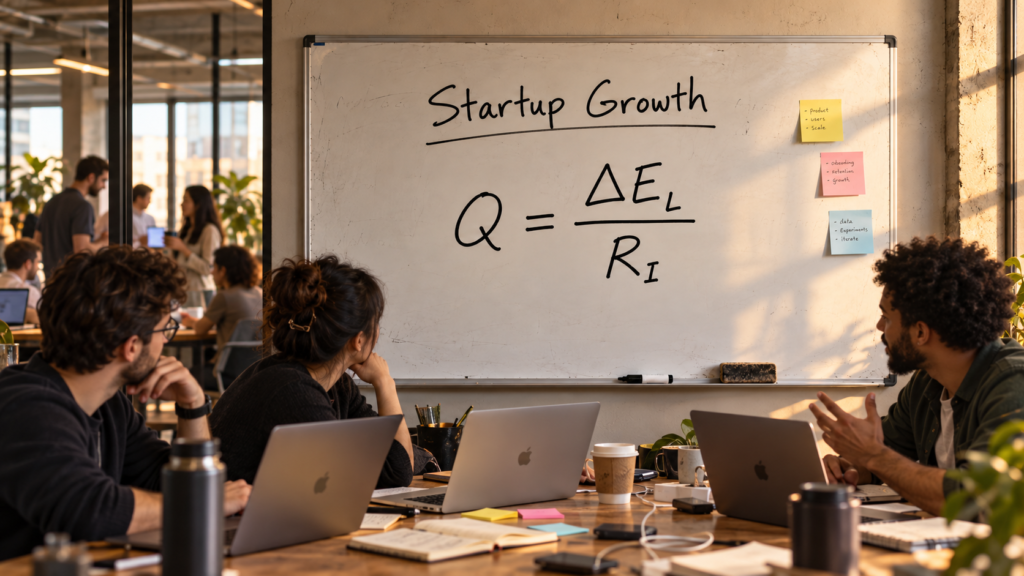
Q=RI/EL
Q is the growth flow, the number of people reaching real, useful adoption in a given period. The numerator, ΔEL, is latent demand pressure, the strength of the reason to move. The denominator, RI, is resistance, the sum of every burden between the person and the result. In marketing these are called objections.
Growth flows where strong pressure meets low resistance.
I want to be careful here, because a formula demands honesty before anything else. I am not telling you this is a proven law of nature with calibrated units. Customer frustration is not measured in joules. If I tell a founder her pressure is eight and her friction is four, the answer of two is a number I invented. Newton’s gravitational law was in the world for 111 years before Henry Cavendish measured the constant that turned its shape into a prediction. This formula is where Newton was in 1687: the structure is on the table, and the constants are still waiting for their experiment.
What I can say is that the structure behaves the way a good scientific structure should. It tells you what to look at. It tells you what to ignore. And it can be wrong.
Think about what that means for a founder drowning in advice. Every week there is a new channel, a new tool, a new trick. A formula with two terms turns that noise into a single question: does this raise the pressure, or does it lower the resistance? If it does neither, it is decoration.
That connects directly to something I wrote recently, about why growth matters for every startup. I argued that the oil at Spindletop was already pushing against the rock long before anyone drilled, and that the founder’s job is to find the pressure. The formula is that argument with the second half attached.
Go back to that Texas hill. In 1900, Anthony Lucas had read the geology correctly. Pressure existed under the salt dome. His first well still failed at 575 feet, because the sand above the oil kept caving into the hole. The pressure was real. The resistance beat him. Then the Hamill brothers arrived with a rotary rig that pumped heavy mud down the shaft to hold the sand back. They didn’t create one more barrel of pressure. They cut the resistance, and on January 10, 1901, the well came in at an estimated 70,000 to 100,000 barrels a day. That number is a flow. Pressure divided by resistance. Spindletop was the first startup growth formula ever written in mud.
The same formula explains the thing I said about the two halves of a startup’s life. In the first half the whole game is whether any flow starts. Do customers arrive, stay, and tell someone else? That is a pressure and resistance problem, and every first-half failure I can think of is one of three diagnoses: there was never real pressure, the resistance was too high, or the founder was measuring the wrong thing.
The second half asks something the formula alone cannot answer, and I would rather admit that than hide it. A flow of customers is not a profit. GoPro had a pressure in 2014: people wanted to record their lives from where their bodies actually were, and the company turned that into $1.394 billion in revenue and $187 million in operating income. By 2025 its revenue had fallen to $652 million and it posted a net loss of about $93 million. In the second quarter of 2026 its revenue was roughly $105 million, down more than 31 percent, and in September it announced new financing to strengthen its liquidity.
You can read that story through the formula. The phone in your pocket has nearly zero resistance, because you already own it, it already works, and its video keeps improving. Even if the pressure to film an adventure never changed, a competitor with almost no friction quietly rewrote the denominator. That is a hypothesis, not a proof. But it is a hypothesis that tells you where to look, which is what Darcy’s cylinder did for the sand.
That is also why I keep saying the formula belongs to the first half of the story. It governs whether a flow begins. Whether the flow becomes a business depends on what each customer costs to find and serve, and on whether they stay. Those are different measurements, and they need their own work. The mistake would be to treat Q as profit, or to treat profit as a reason to stop watching Q.
Now let me show you what resistance looks like, because it is the part founders consistently underestimate.
Picture the manager of a small maintenance firm with six technicians. This is a hypothetical, but I’ve watched real versions of her. She runs tomorrow’s jobs from Excel, WhatsApp, and a lot of phone calls. A cancellation arrives late. One technician has the wrong address. Another never saw the revised schedule. By evening, tomorrow exists in several places, and none of them is entirely reliable. What she wants is not scheduling software. She wants to stop being the person through whom every correction must pass. That is the pressure.
Now a founder offers her a free trial. Before she can schedule a single job, the product asks her to import all her customers, create profiles for every technician, define service categories, connect a calendar, and invite her team. The dashboard promises order, and reaching it requires an administrative expedition. She closes the tab. Analytics records an abandonment. The founder suspects the color of the button.
The customer paid before the invoice arrived. She paid in afternoons, in worry, in the labor of persuading six other people. Free is not the same as cheap.
Some friction is a handrail, though. A confirmation before deleting records, a clear explanation of permissions, a chance to check a message before it goes out: these add steps and subtract fear. A formula that treated all friction as bad would be a bad formula. The honest denominator is the whole burden of reaching a result you can trust.
You can also lower resistance without touching the product’s core. Let her schedule one real job and send one clear update before reorganizing anything. Let her see her own result before she brings her data. Keep the old system available while she decides. None of that changes how badly she wants to stop being the switchboard. It changes how much she has to risk to find out the product works.
I have another reason to care about this, and it is the AI era. A founder on a MacBook Air can now open Cursor, type a sentence, and have a working product before her coffee cools. Claude Code, Lovable, and Replit can sink a dozen wells before lunch. The product half of product-market fit has been substantially automated.
The market half has not moved. The pressure is still inside a human being, in a situation, at a moment. And resistance has not collapsed either, because the denominator never lived inside the code. It lives in trust, habit, politics, and verification. If an AI tool drafts a report in seconds but the customer spends an hour correcting it, the work has been relocated, not removed. The honest measure sits at the point where the customer can safely use the result.
This is where rivals and incumbents change the math. Another startup, using the same models on the same day, can match your features by Friday. An incumbent already holds the customer’s records, contracts, and trust, which means its resistance is lower than yours before either of you has shipped anything. Cheaper drilling raises the price of knowing where to drill.
So how do you know whether the formula is science or storytelling? The same way Halley did.
Halley used Newton’s laws to predict that a comet seen in 1682 would return around 1758. He did not live to see it. When it returned, right on schedule, the equation had earned its authority by risking embarrassment. A formula that cannot be wrong is a horoscope.
So here is how I’d test mine. Imagine two hundred qualified prospects reaching a product in a week, and forty of them reach the first useful result. That’s twenty percent. Now imagine the founder predicts that importing records is the bottleneck, removes the import, and sends the next two hundred comparable prospects through. If sixty reach the useful result, she has evidence of an improvement. If the number stays at forty, the explanation is wrong, and she has just saved a month of decorating a bad theory. Either answer teaches her something. The claim was allowed to lose.
That is the discipline I want founders to take away: write the prediction down before the test, because memory is a generous editor. And keep the three questions plain. Where is the desire already showing itself? What stands between those people and the result? What change would reduce that burden enough to alter behavior? Every one of those points at something you can watch.
There are limits, and I would rather name them than have someone else do it. If resistance drops toward zero, the notation suggests infinite flow. It doesn’t mean that. A market has a finite number of people, and another constraint takes over as one obstacle recedes. Retention matters too: an acquisition report can look wonderful while the base stays flat, because every new arrival is replacing a departure. The formula describes how adoption begins. It doesn’t promise it will last. That job belongs to what I said about the second half.
Founders also don’t control all of it. They can influence pressure through education and demonstration, and they can lower resistance through design and trust. They cannot control procurement, budgets, or the calendar on someone else’s desk. Good strategy separates what can be changed from what must be accommodated.
Three stories now, one shape. Instagram’s founders watched people sharing photos that had passed through other filter apps, noticed the pressure, and focused the product on lowering the effort and the embarrassment of sharing. ChatGPT arrived in November 2022 as a conversation instead of a code editor and made experimenting with a capable model feel like asking a question. A maintenance manager closes a tab. Three different markets, one set of questions. How badly do they want it, and how much does it cost them to get it?
That is the thread, and it is the same thread that ran through Dijon, Heidelberg, Cambridge, and Cologne. Someone refuses to accept that the surface chaos is the whole story. Someone picks the two variables that matter. Someone writes them as a line.
I think about Darcy a lot now. He wasn’t trying to make a law. He was trying to give a city clean water. He built a cylinder, poured in sand, and measured. His formula became the foundation of how we understand groundwater, oil reservoirs, and the movement of contaminants through soil, and in some sense it is the reason we can drill for oil at all.
Which brings me back to the first sentence. Growth isn’t a mystery. It is a ratio nobody bothered to write down. When I say that, I’m not claiming growth is simple, or that the work is easy, or that a founder who reads this essay will find the answer by Friday. I’m saying that the people who told you startup growth was weather were making Comte’s mistake, mistaking the absence of a measurement for the absence of a pattern.
If this works, it will be because someone tests it, breaks it, refines it, and eventually does for the formula what Cavendish did for Newton’s. I would like that person to be hostile and rigorous. I would like them to try to prove me wrong.
Picture a founder tomorrow morning. A customer’s tab closed at the third step of onboarding. She can look at that and see a verdict. Or she can see a single data point about the sand. She can ask how much water this pressure was supposed to push, and what the resistance did to it.
The water was always going to move. Someone just had to measure the sand.
Find the pressure. Remove the unnecessary work. Startup Growth System is a 90-minute course for founders who have shipped without customers, have users without clear product-market fit, or have found demand and now need to scale. Six frameworks connect customer understanding, strategy, distribution, and growth decisions. Explore the course and watch the introduction — $149.